

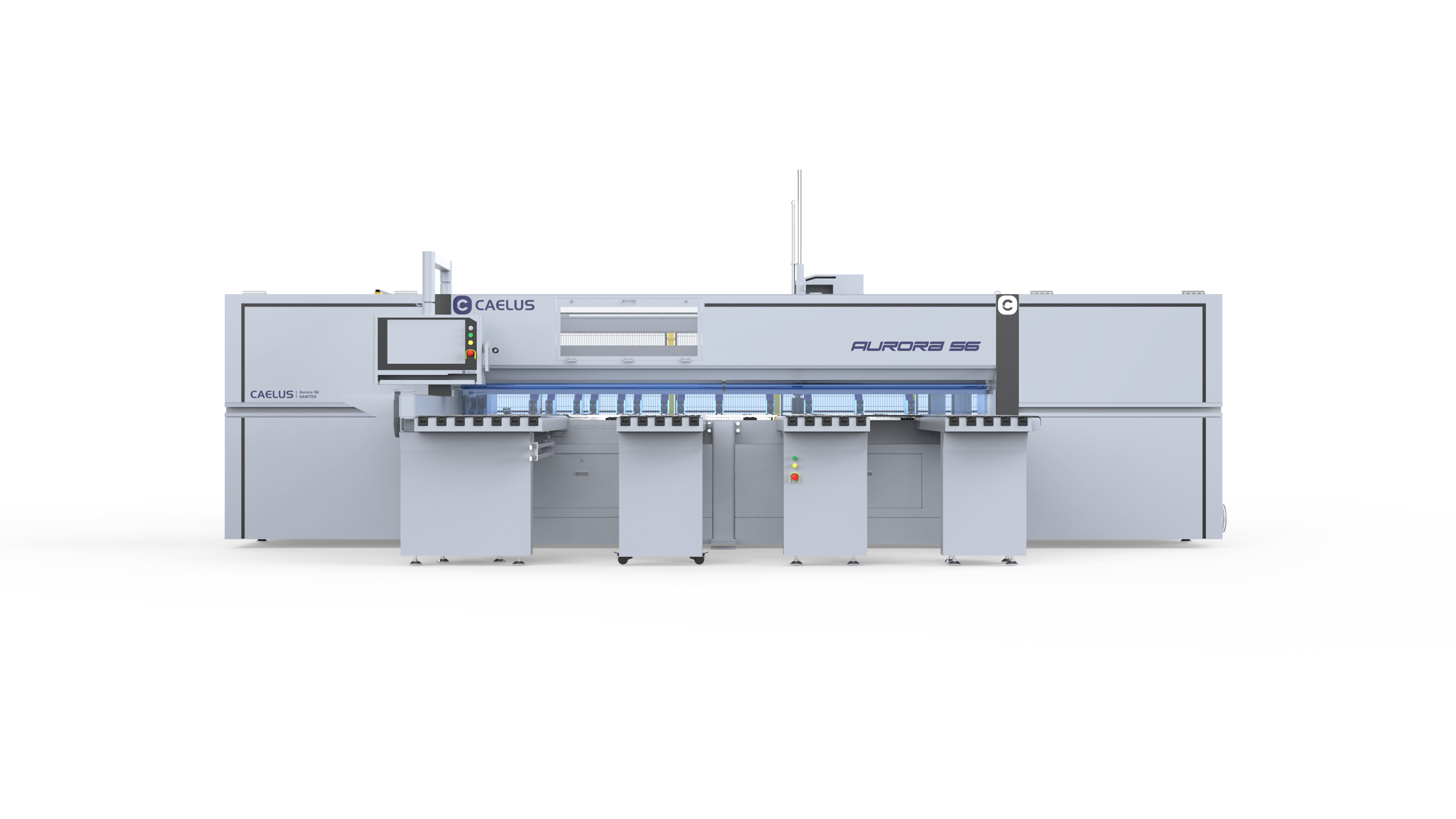
In the modern furniture manufacturing industry, solid wood is no longer the dominant material. Composite panels, with their excellent physical stability and high cost-effectiveness, have become irreplaceable mainstream materials. Whether it is the commonly seen MDF (medium-density fiberboard), particleboard, plywood, or laminated boards, they form the cornerstones of modern whole-house customization and mass-produced furniture. However, the cutting quality of composite panels is like the first domino in a chain reaction, directly affecting all subsequent processes including:
- Edge Banding: Even tiny burrs on the cut edges can lead to poor edge banding adhesion, unsightly black lines, and even later delamination.
- Assembly Precision: Millimeter-level dimensional errors are magnified during assembly, resulting in non-square cabinets and uneven gaps between the door panels.
- Finished Product Quality: Cutting chipping is a direct cause of customer returns and a decline in brand reputation.
Incorrect cutting methods not only lead to severe chipping and dimensional errors but also cause excessive material waste. This gives rise to a core issue that concerns all furniture factory owners and production managers: how to efficiently and accurately cut composite panels?
What is a composite panel?
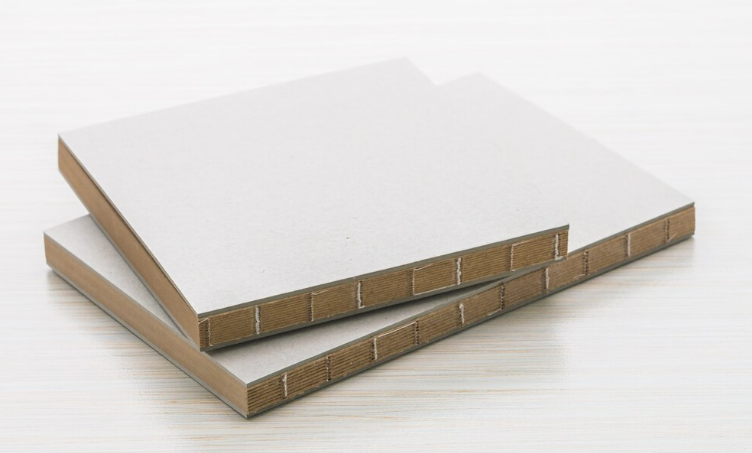
composite panel
What Are the Cutting Challenges of Composite Panels?
Understanding the Structural Characteristics of Composite Panels
Mastering material properties is the fundamental prerequisite for optimal processing. Composite panels differ from homogeneous solid wood and feature a typical multi-layer composite structure: their core is often composed of loose wood shavings or dense plant fibers with varying density levels, while the surface is bonded with an ultra-thin, brittle decorative veneer such as melamine or laminate. This sandwich structure—characterized by a rigid exterior and a relatively soft interior, or disparate material properties across layers—poses significant technical challenges for mechanical cutting operations.
Key Cutting Challenges
- Edge chipping
High-speed rotating saw blades cutting through brittle surface veneers are prone to causing flaking and cracking, in the absence of professional back support or precision pre-cutting processes.
- Interlayer delamination
For plywood and similar laminated materials, the vertical tearing force generated during cutting can easily lead to delamination between the bonded layers.
- Ultra-high precision requirements
Modern furniture manufacturing processes, including CNC drilling and concealed hardware installation, demand cutting dimensional errors to be strictly controlled within a tolerance of ±0.1mm.
- High-efficiency batch processing demands
Faced with large-volume production orders, cutting equipment must not only ensure consistent precision but also maintain high processing speed and long-term stable operation.
It is clear that traditional manual cutting tools can no longer meet the stringent quality and efficiency requirements of modern furniture manufacturing.
Comparison of Common Composite Panel Cutting Methods
To overcome the above difficulties, various cutting machine has evolved in the industry.
Manual Cutting (Table Saw / Hand Saw)
This is the most basic cutting method using a table saw or hand saw. Its advantages include extremely low equipment cost and simple operation. However, its critical drawback is that cutting accuracy depends entirely on workers’ skills and experience, leading to high labor intensity and a high risk of workplace injuries. As such, manual cutting is completely unsuitable for large scale standardized production.
CNC Panel Saw
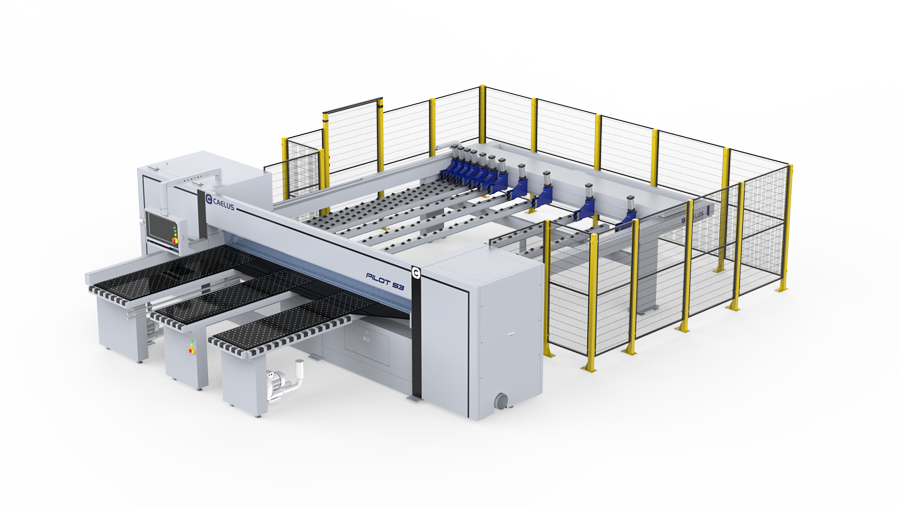
The CNC panel saw is a key solution for digital furniture manufacturing.
Advantages: With a professional CNC system, it provides high cutting precision and automatic positioning, eliminating human errors. Its friendly software interface supports efficient batch processing and flexible size switching.
Suitable for: Medium and large furniture factories with fragmented orders and whole house customization companies.
Beam Saw (Electronic Panel Saw)
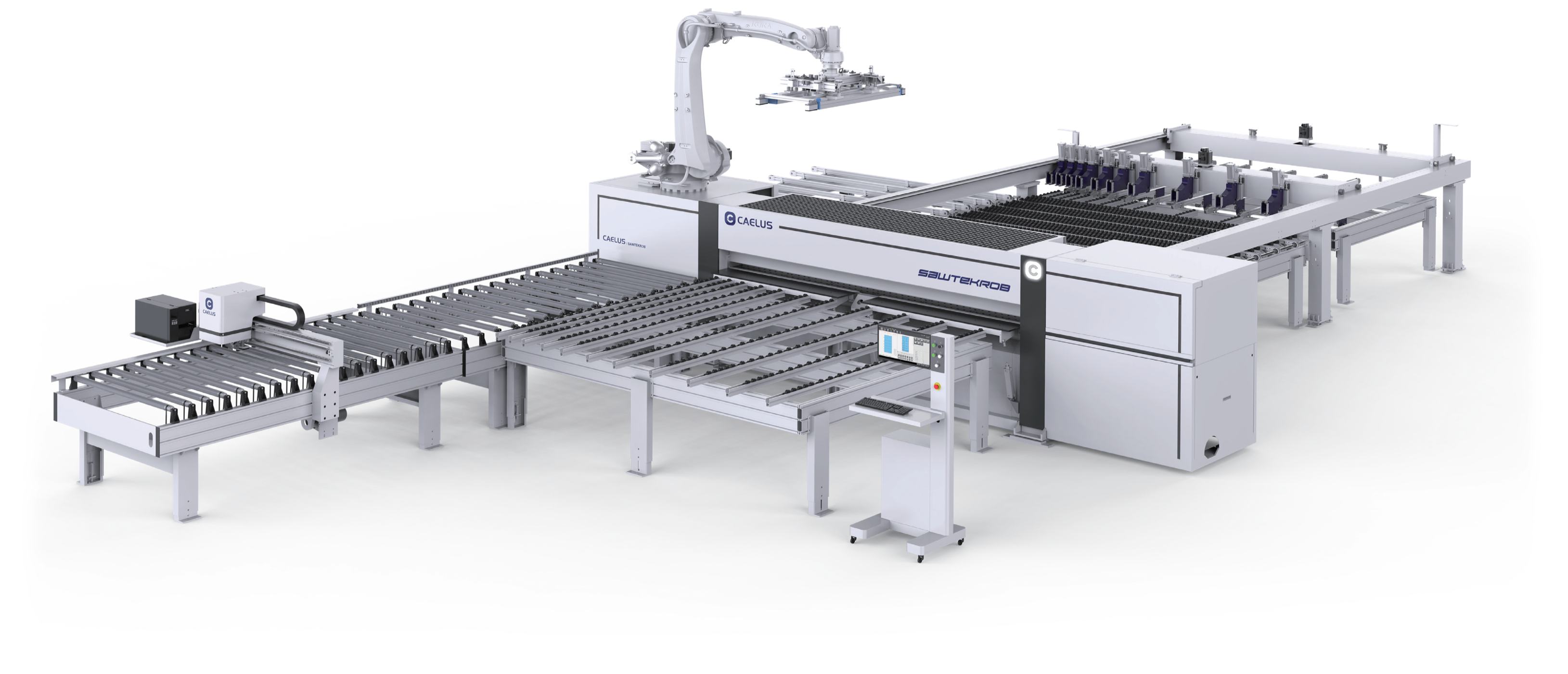
Caelus Panel Saw SawTekRob 5 Flexible Cutting Cell
When processing large quantities of uniformly sized panels, the beam saw delivers unmatched efficiency.
Advantages: Its heavy-duty beam structure and pressure system ensure exceptional cutting stability. It excels at batch cutting of stacked boards, and with automatic optimization software, it maximizes material utilization.
Suitable for: Highly standardized industrial furniture manufacturing bases.
Automatic Panel Saw
The automatic panel saw is a further upgrade based on CNC. Advantages: It integrates automatic feeding suction cups, automatic pressure cylinders, and an automatic cutting cycle system. The operator only needs to monitor the screen, and the machine continuously outputs precise panels. It significantly reduces manual handling and auxiliary time, making it the ultimate choice for improving the overall processing efficiency of composite panels.
Panel Saw vs. Beam Saw
Which is better for cutting composite panels? When factories are preparing to upgrade their machine, panel saw vs. beam saw is the most frequently compared topic. We will analyze it in depth from four core dimensions:
Cutting Precision
CNC panel saws, due to their use of precision servo motors to control the stop and push table, achieve extremely high precision when handling complex single-sheet cuts. Beam saws, with their large pressure beams, effectively prevent panel slippage when handling multi-panel stacking, making them more suitable for maintaining precision in batch repetitive cutting.
Production Efficiency
If the order is "few varieties, large batch," the efficiency of beam saw stacking is unparalleled. However, if the order is "multiple varieties, small batch" (such as custom wardrobes), automatic panel saws, with their fast response speed and extremely flexible order changeover capabilities, will have higher actual production efficiency.
Investment Costs
Generally, beam saws have a larger mechanical structure, occupy more space, and have a higher initial investment. Standard high-end CNC panel saws, on the other hand, have a compact footprint, more flexible funding requirements, and a very high return on investment (ROI).
Applicable Factory Scale
Table 1: Machine Recommendation by Factory Scale
|
Factory Scale |
Recommended Machine |
Key Advantage |
|
Small Factory |
cnc panel saw |
High precision, flexible for varied custom sizes, affordable investment. |
|
Medium Factory |
automatic panel saw |
Automated feeding/cutting reduces labor, high efficiency for mixed batches. |
|
Large Factory |
beam saw |
Maximum throughput, stack cutting capability, stable for mass production. |
How to Choose the Right Composite Panel Saw?
Faced with a dazzling array of machine on the market, choosing a suitable composite panel saw requires considering the following core criteria:
- Cutting Accuracy: Pay attention to the rigidity of the frame and the type of guide rails. A high-strength machine body can absorb cutting vibrations.
- Automation Level: Does it have functions such as automatic saw blade lifting and automatic positioning stop?
- Saw Blade Quality and Structure: It must have a dual-saw structure of "main saw + scoring saw," which is a physical prerequisite for preventing composite panel edge chipping.
- Layout Optimization System: Excellent software can increase board utilization by 5%-10%, which is a huge hidden asset.
- Machine Integration Capabilities: Can it communicate with the factory's existing ERP/MES system? Can it share data with backend edge banding machine?
In this regard, the Caelus Panel Saw series provides a textbook example. Whether it's the entry-level Pilot S3/S5 or the high-performance Aurora S6/S8, the entire Caelus series comes standard with a high-rigidity structure and a high-precision servo/linear drive system, ensuring cutting position precision reaches industrial-grade standards. Its ingenious combination of the main saw and the scribing saw perfectly solves the pain point of edge chipping during panel cutting, laying a solid foundation for subsequent perfect edge banding.
Automation Trends: From Single-Machine Cutting to Intelligent Production Lines
In the wave of Industry 4.0, composite panel cutting is no longer an isolated action; it has become a core node in automated furniture manufacturing.
In the factories of the future, CNC panel saws or automatic panel saws will no longer require manual pushing of panels to the machine. These systems will be deeply integrated with automated storage systems (such as Caelus's StoreTek 5 intelligent storage system) to achieve automatic board recall and intelligent loading. After cutting, the boards are automatically labeled with QR codes and directly enter the Edge Bander station.
Through automatic layout optimization in software and seamless hardware integration, manual intervention is minimized, the cutting error rate is near zero, and the factory truly achieves data-driven, flexible, and continuous production.
Overview of Major Global Panel Saw Manufacturers
When evaluating panel saw manufacturers, we must consider not only brand reputation but also their underlying technological capabilities, automated production line integration capabilities, and localized after-sales support.
Currently, the global market exhibits a polarized pattern. European high-end brands have a long history and deep expertise in heavy woodworking machinery, but their high machine prices and long maintenance response cycles deter many medium-sized enterprises. Meanwhile, Chinese intelligent manufacturers, represented by Caelus, are rapidly emerging. They not only match or surpass international standards in single-machine performance (such as servo control and linear motor applications), but also demonstrate overwhelming advantages in software interconnectivity and cost-effectiveness. Caelus provides more than just a saw; it offers a complete, highly customized, flexible, and intelligent production line encompassing cutting, warehousing, and edge banding, truly achieving a "turnkey" level system engineering service.
Common Composite Panel Cutting Problems and Solutions
Even with top-of-the-line machine, attention to detail is crucial in daily operation:
- Edge chipping: 90% of edge chipping is due to improper adjustment of the secondary saw (scoring saw). Ensure the main and secondary saws are on the same straight line, and the cutting width of the secondary saw is slightly larger than that of the main saw by 0.1-0.2mm.
- Dimensional errors: Regularly use a dial indicator to calibrate the parallelism of the machine's guide rail and push table, and check for loose servo motor belts.
- Low cutting efficiency: Upgrade and optimize the layout software to consolidate scattered orders; utilize automatic loading and unloading devices to reduce auxiliary downtime.
- Saw blade wear is rapid: Select saw blades with appropriate tooth profiles and materials (such as alloys or diamonds) for materials of different densities; ensure the saw blade's depth of cut is 15-20mm above the board surface for optimal heat dissipation and chip removal.
FAQ
Q1: What is the best saw for cutting composite panels?
For high-volume standard production, a Beam Saw with a pressure beam and optimized software is the best choice; for multi-variety customized production, a CNC Panel Saw or Automatic Panel Saw with high-precision control offers greater flexibility.
Q2: Is a beam saw better than a CNC panel saw?
Not necessarily, but rather depending on the application scenario. In the comparison between panel saws and beam saws, Beam Saws excel in heavy-duty overlapping cuts and straight-line stability, while CNC Panel Saws are more advantageous in handling complex dimensions and floor space requirements.
Q3: How to avoid chipping when cutting composite panels?
The key is to use a device equipped with a "scoring saw" to pre-cut the fragile bottom veneer layer before the main saw cuts through. Meanwhile, keep the saw blade sharp and adjust to the correct sawing height.
Q4: What is the difference between a panel saw and a beam saw?
Traditional panel saws rely on manual operation to push the slide or feed the board, offering high flexibility; beam saws, on the other hand, have a large horizontal pressure beam to hold the board in place, with the saw carriage moving at high speed below to complete the cut, making them fully automated heavy-duty machine.
Q5: Can an automatic panel saw improve production efficiency?
Absolutely. Through automatic feeding, automatic positioning, and intelligent layout, it eliminates the waiting time for manual measurement and handling, maximizing production cycle time and becoming a powerful tool for factories to reduce costs and increase efficiency.
Conclusion
Undoubtedly, the cutting quality of composite panels is the lifeline of the precision of finished furniture manufacturing products. In this era of low profit margins, every precise cut creates profit for the company, while every waste product erodes the bottom line.
Choosing a suitable composite panel saw is a strategic decision that every furniture business owner must make correctly. For medium to large-sized factories pursuing efficiency and quality, abandoning outdated manual machine and embracing automated panel saws or beam saws with system-wide integration capabilities is no longer a choice, but a matter of survival.
On the road to automation upgrades, choosing a top-tier machine manufacturer like Caelus, which understands processes and systems, will help you stay one step ahead in the fierce market competition. Need further information on how to upgrade your cutting process? You can view this high-end cutting solution with top-tier servo control and anti-chipping design to obtain detailed technical parameters.