

In furniture manufacturing, panels are the starting point of almost every production process. Before cutting, edge banding, drilling, grooving, assembly, or packaging begins, factories need to store and handle large quantities of wood-based panels safely and efficiently.
A panel storage system is designed for exactly this purpose. It helps furniture factories store, organize, retrieve, and transport panels such as MDF, particle board, plywood, melamine board, laminated panels, and decorative sheets. More than a simple storage rack, a modern panel storage system can become an important part of the entire production workflow.
For furniture manufacturers, the way panels are stored directly affects production speed, material waste, labor cost, workshop safety, and cutting efficiency. When panels are stacked randomly on the floor, workers spend more time searching, lifting, moving, and re-stacking materials. Panels may also be scratched, bent, chipped, or damaged before they even reach the panel saw.
A well-designed panel storage system solves these problems by creating a cleaner, safer, and more organized material handling process.
What Is a Panel Storage System?
A panel storage system is a specialized material handling and storage solution used in furniture manufacturing to safely store, organize, protect, and retrieve large wood-based panels such as MDF, plywood, particle board, and laminated boards before cutting and processing.
It is commonly used for:
- MDF panels
- Particle board
- Plywood
- Melamine-faced boards
- Veneered panels
- Laminated panels
- Acrylic panels
- Door panels
- Cabinet panels
- Decorative boards
- Offcuts and semi-finished panels
Unlike ordinary warehouse shelving, a panel storage system is designed around the size, weight, surface condition, and picking frequency of furniture panels. It must consider not only storage capacity, but also how panels enter the storage area, how they are retrieved, how they move to the panel saw, and how the system supports daily production.
Why Panel Storage Matters in Furniture Manufacturing
Furniture factories often handle hundreds or even thousands of panels every day. Each panel may vary in material, thickness, color, surface finish, and order requirement. Without a structured storage system, the workshop can quickly become crowded and inefficient.
1. Improve Space Utilization
Large-format panels occupy a lot of floor space when stored horizontally or stacked randomly. A planned storage system allows the factory to use space more efficiently and keep material areas cleaner.
2. Protect Panel Surfaces and Edges
Decorative panels, melamine boards, veneered boards, and high-gloss panels can easily be scratched or damaged during manual handling. Proper storage reduces unnecessary movement and contact between panels.
3. Increase Material Picking Speed
Workers can locate the right panel by material, thickness, color, batch, or production order. This reduces searching time and avoids production delays.
4. Reduce Labor Intensity
Moving heavy panels manually is slow and physically demanding. A better system can work with forklifts, vacuum lifters, automatic loading devices, or panel saws to reduce manual handling.
5. Improve Workshop Safety
Poorly stacked panels may slide, tilt, or collapse. A professional storage system helps create a safer working environment and more predictable material flow.
Common Types of Panel Storage Systems
Different factories need different storage methods. The right choice depends on panel size, production volume, workshop layout, automation level, and budget.
1. Vertical Panel Storage System
A vertical panel storage system stores panels upright or at a slight angle. It is commonly used in small and medium-sized workshops where space is limited and quick visual identification is important.
This type of system is suitable for storing multiple panel types in a compact area. Workers can separate panels by material, color, or thickness, making it easier to find the correct sheet.
Advantages:
- Saves floor space
- Makes panel categories easier to identify
- Suitable for mixed panel inventory
- Reduces the need to move entire stacks
- Works well for workshops with limited space
Best for: cabinet factories, custom furniture shops, small panel processing workshops, and factories with many panel types but moderate inventory volume.
2. Horizontal Panel Rack
A horizontal panel rack stores panels flat in layers or stacks. This is a traditional method and is still useful for bulk storage of the same panel type.
It is suitable when a factory stores large quantities of identical panels and uses forklifts for loading and unloading. However, it may not be the best option when different panels need to be picked frequently, because workers may need to remove upper panels to access lower ones.
Advantages:
- Simple structure
- Suitable for high-volume storage
- Works with forklift handling
- Good for standard-size panels
Limitations:
- Lower panels are harder to access
- More re-stacking may be required
- Surface damage may occur if panels slide against each other
- Not ideal for frequent small-batch picking
Best for: bulk material warehouses, factories with large inventory of standard boards, and upstream panel preparation areas.
3. Roll-Out or Drawer-Type Panel Storage System
A roll-out panel storage system uses sliding shelves, drawers, or movable sections to make panel access easier. Instead of moving an entire stack, workers can pull out a storage level and retrieve the required panel more conveniently.
This type is useful when factories handle many panel sizes or high-value decorative panels that require better protection.
Advantages:
- Easier access to individual panel groups
- Better organization for different panel types
- Reduces unnecessary panel movement
- Helps protect panel surfaces
- Suitable for high-mix production
Best for: custom furniture factories, decorative panel workshops, cabinet door production, and factories that handle many surface finishes.
4. Automated Panel Storage System
An automated panel storage system is designed for modern furniture manufacturing lines. It can automatically store, sort, retrieve, buffer, and deliver panels to downstream equipment such as panel saws, CNC machines, or flexible cutting cells.
This type of system is not just a storage rack. It is part of a smart production workflow. It can help reduce manual handling, improve scheduling efficiency, and support continuous production.
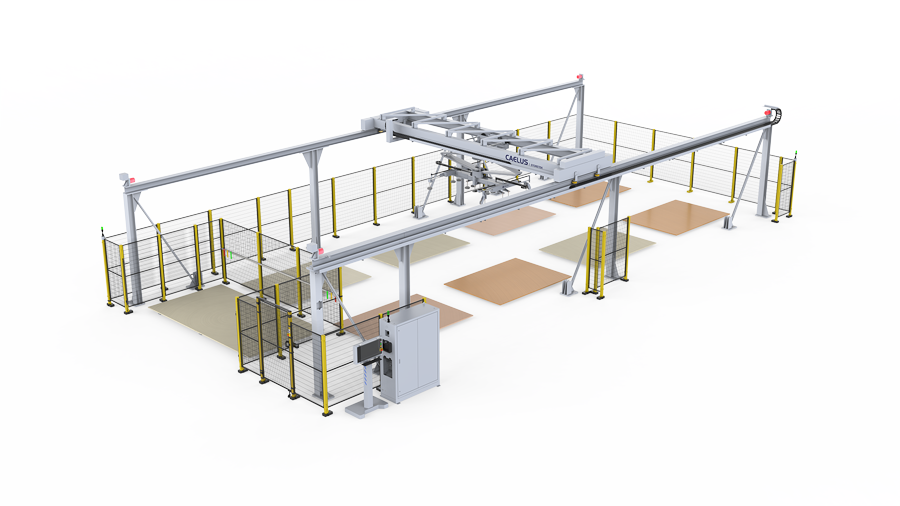
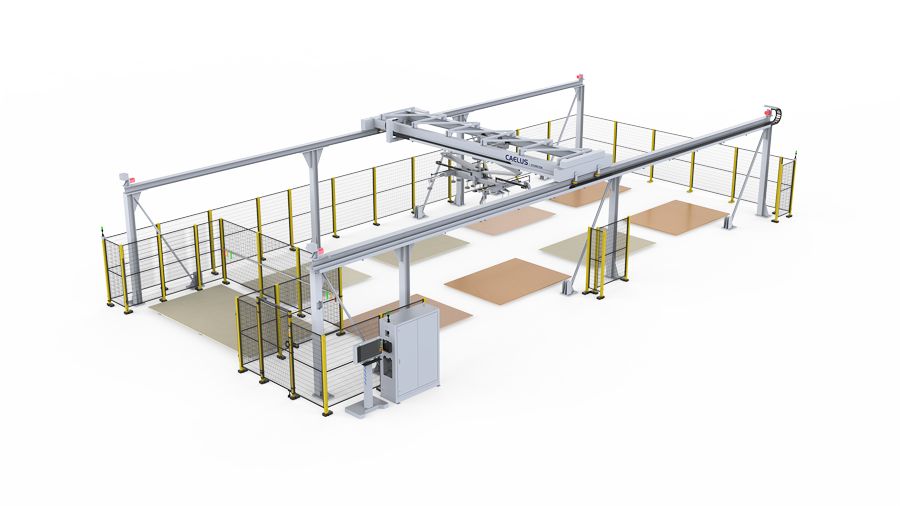
For example, CAELUS StoreTek 5 is designed with intelligent sorting, dynamic buffering, autonomous scheduling, and seamless coordination between the storage system and the panel saw. It can be combined with front-loading panel saws, rear-loading panel saws, flexible cutting cells, and CNC equipment.
Advantages:
- Supports automatic infeed and outfeed
- Reduces labor requirements
- Improves panel preparation speed
- Connects storage with cutting processes
- Supports intelligent scheduling
- Helps reduce waiting time before cutting
- Suitable for high-volume and customized production
Best for: medium and large furniture factories, panel furniture manufacturers, smart factory projects, and automated production lines.
How to Choose the Right Panel Storage System
Choosing a panel storage system is not only about buying equipment. It is about matching storage design with real production needs. Before selecting a system, furniture manufacturers should consider the following factors.
1. Panel Size
Start with the largest and most common panel sizes used in your factory.
Common panel sizes may include:
- 2440 × 1220 mm
- 2800 × 2070 mm
- 3050 × 1220 mm
- 4 × 8 ft
- 5 × 10 ft
You should confirm:
- Maximum panel length
- Maximum panel width
- Minimum and maximum thickness
- Whether oversized panels are used
- Whether offcuts need to be stored
For automated systems, panel size directly affects system range, carriage travel, suction configuration, and storage layout.
2. Panel Weight and Load Capacity
Load capacity is one of the most important safety factors. A storage system must be designed according to the real weight of panels, not just the number of sheets.
Different materials have different densities. MDF, particle board, plywood, laminated boards, and fire-rated panels may vary significantly in weight. Thicker panels also increase the load quickly.
When evaluating a system, ask about:
- Maximum panel weight
- Total storage capacity
- Load capacity per storage area
- Dynamic load during movement
- Safety factor
- Floor load requirements
- Overload protection
For example, CAELUS StoreTek 5 lists a maximum panel weight of 250 kg, with technical data covering storage width, travel path, panel length, panel width, thickness, stack height, and movement speeds. These specifications are important because automated storage must be selected based on both material size and production rhythm.
3. Production Volume
A small workshop and a high-volume furniture factory do not need the same type of system.
For small workshops, a vertical or drawer-type storage system may be enough. For medium-sized factories, a semi-automatic or roll-out system may improve picking and reduce labor. For large manufacturers, an automated panel storage system connected to panel saws can deliver stronger value.
Consider:
- How many panels are processed per shift
- How many panel types are stored
- How often panels are retrieved
- Whether production is batch-based or order-based
- Whether the factory handles customized furniture
Customized furniture manufacturing usually requires more flexible storage because orders change frequently and panel types are more diverse.
4. Connection with Panel Saw and CNC Equipment
A panel storage system should not be considered separately from the cutting process. In many factories, the real bottleneck is not storage capacity, but the connection between storage and cutting.
If workers still need to manually find, lift, and feed panels into the panel saw, the cutting line may not reach its full efficiency.
Modern automated storage systems can coordinate with:
- Front-loading panel saws
- Rear-loading panel saws
- CNC panel saws
- Flexible cutting cells
- Nesting machines
- CNC drilling lines
- Factory scheduling systems
This connection helps reduce waiting time and makes material preparation more accurate.
5. Workshop Layout
The best panel storage system must fit the workshop layout. Even a high-performance system may underperform if installed in the wrong position.
Before purchasing, evaluate:
- Material receiving area
- Panel storage zone
- Cutting area
- Forklift path
- Worker access
- Machine loading direction
- Ceiling height
- Floor condition
- Fire and safety access
- Future expansion space
A good supplier should understand your production flow before recommending a solution.
6. Automation Level
Not every factory needs full automation immediately. The right automation level depends on business goals, labor cost, production volume, and investment plan.
You can choose from:
- Manual storage
- Semi-automatic handling
- Roll-out storage
- Automatic panel retrieval
- Automated storage connected with panel saw
- Full storage and cutting automation
For factories planning long-term growth, it is often better to choose a system that can be expanded or integrated with future automation.
7. Offcut Management
Offcuts are often overlooked, but they represent real material value. In panel furniture manufacturing, leftover panels from cutting may still be useful for smaller parts or future orders.
If offcuts are not managed well, they become waste or occupy too much space.
A good panel storage solution should help factories separate, identify, and reuse offcuts where possible. CAELUS StoreTek 5 is positioned to support panel saw solutions and offcut management, helping turn material waste into usable value.
Manual Storage vs. Automated Panel Storage
Many buyers ask whether they really need an automated panel storage system. The answer depends on the factory's production situation.
| Factor | Manual Panel Storage | Automated Panel Storage |
|---|---|---|
| Investment cost | Lower | Higher |
| Labor requirement | Higher | Lower |
| Picking speed | Depends on workers | Faster and more consistent |
| Panel tracking | Manual | Can support digital management |
| Panel saw connection | Limited | Stronger integration |
| Best for | Small workshops | Medium and large factories |
| Scalability | Limited | Better for smart factories |
Manual systems can be practical for smaller operations. However, as production volume increases, manual storage may become a bottleneck. Automated systems are more suitable when factories need higher throughput, better material control, and closer integration with cutting lines.
Key Benefits of an Automated Panel Storage System
For furniture manufacturers moving toward automation, an intelligent panel storage system can create value in several ways.
Faster Material Preparation: The system can prepare panels according to the production schedule, reducing the waiting time before cutting.
Reduced Labor Dependence: Automatic infeed and outfeed reduce the need for workers to manually move large panels.
Better Cutting Line Efficiency: When storage and panel saws work together, the cutting process becomes smoother and more continuous.
Improved Panel Management: Different panel specifications can be stored and retrieved more systematically.
Lower Risk of Material Errors: Automated scheduling and positioning can reduce the chance of sending the wrong panel to production.
Support for Smart Factory Development: A storage system connected with cutting equipment, software, and production planning can become part of a digital manufacturing workflow.
Common Mistakes When Buying a Panel Storage System
A panel storage system is a long-term investment. Avoiding the following mistakes can help factories choose a more suitable solution.
Mistake 1: Only Comparing Price
The cheapest system may not offer the right structure, load capacity, safety design, or future expandability. For heavy panels, weak storage design can create safety risks and long-term maintenance problems.
Mistake 2: Ignoring Real Panel Weight
Some buyers only consider panel dimensions but forget weight. This can lead to overloading, unstable storage, and premature wear.
Mistake 3: Not Considering Production Flow
A storage system should match the cutting process. If panels still need long-distance transport to the panel saw, the factory may not gain much efficiency.
Mistake 4: Forgetting Future Expansion
Furniture factories often grow. A system that only fits current production may become insufficient after new machines or new product lines are added.
Mistake 5: Ignoring Software and Automation Compatibility
For automated production, hardware alone is not enough. The system should be able to communicate with other equipment and support production scheduling.
Why Choose CAELUS for Panel Storage and Automated Furniture Manufacturing?
CAELUS focuses on intelligent woodworking machinery and automated furniture manufacturing solutions. Its product portfolio covers panel storage systems, panel saws, edge banders, flexible cutting cells, and automation solutions for modern panel furniture production.
The CAELUS StoreTek 5 Storage System is designed for intelligent panel management. It supports sorting, buffering, autonomous scheduling, and coordination with panel saws. It can be combined with different cutting solutions, including front-loading panel saws, rear-loading panel saws, flexible cutting cells, and CNC equipment.
For factories that want to upgrade from traditional panel stacking to automated material handling, CAELUS can help design a storage and cutting solution based on panel size, production capacity, workshop layout, and automation goals.
Conclusion
A panel storage system helps furniture manufacturers store, organize, protect, and retrieve MDF, plywood, particle board, laminated panels, and offcuts more efficiently. By improving space use, reducing panel damage, speeding up material picking, and connecting storage with panel saws or automation lines, it creates a safer, cleaner, and more productive workshop. For factories moving from manual stacking to smart production, it is a key step toward better material flow and lower operating costs.
FAQ
Q1. Why do furniture factories need a panel storage system?
A: Furniture factories need a panel storage system to reduce messy stacking, save floor space, protect panel surfaces, improve material picking speed, and create a safer production environment.
Q2. How can a panel storage system reduce panel damage?
A: It reduces unnecessary panel movement, prevents random stacking, and helps separate panels by material, size, thickness, or surface finish. This lowers the risk of scratches, chipped edges, bending, and surface damage before cutting.
Q3. Is a panel storage system suitable for MDF, plywood, and particle board?
A: Yes. A panel storage system can be used for MDF, plywood, particle board, melamine boards, laminated panels, veneered panels, acrylic panels, cabinet panels, door panels, and offcuts.
Q4. When should a factory choose an automated panel storage system?
A: A factory should consider automation when manual picking becomes slow, labor costs increase, panel saws wait for materials, production volume grows, or the factory wants better connection between storage, cutting, and smart manufacturing systems.
Q5. Can a panel storage system work with a panel saw?
A: Yes. An automated panel storage system can be connected with front-loading panel saws, rear-loading panel saws, CNC panel saws, and flexible cutting cells to improve material preparation and cutting efficiency.
Q6. What information is needed before buying a panel storage system?
A: Buyers should prepare panel size, panel weight, material type, thickness range, daily production volume, workshop layout, handling method, required automation level, and whether offcuts need to be stored or reused.