


A CNC panel saw is usually the better fit for fast, repeatable straight cutting of rectangular cabinet parts. A CNC nesting router is usually the better fit for custom orders that need drilling, grooves, cutouts, or shaped profiles in the same workflow.
The right choice depends on more than cutting speed. Part mix, order volume, downstream drilling capacity, material flow, labour, software, and edge-banding capacity all affect total output and cost. For many growing cabinet factories, the most effective answer is not choosing one machine over the other, but assigning each machine the parts it processes best.
What Is the Main Difference?
A CNC panel saw, often called a beam saw in high-volume applications, is designed to divide sheet material into accurately sized rectangular parts. It is well suited to standard cabinet sides, shelves, backs, fillers, and toe kicks that need clean straight cuts before edge banding or assembly.
A CNC nesting router holds a full sheet on a vacuum table and follows a digital machining program. Depending on its configuration, it can nest parts, cut profiles, drill face holes, route grooves, create special cutouts, print labels, and send finished parts to the next process.
The key difference is simple:
- A CNC panel saw specializes in fast straight cutting.
- A CNC nesting router combines cutting with selected machining operations.
Neither approach is automatically better. The correct choice depends on what happens to each part after it is cut.
CNC Panel Saw vs CNC Router: Key Differences
| Decision factor | CNC Panel Saw / Beam Saw | CNC Nesting Router |
|---|---|---|
| Primary strength | Fast, repeatable straight cutting | Nested cutting and programmed machining from one sheet |
| Best-fit parts | Standard rectangular panels | Parts with holes, grooves, profiles, or changing dimensions |
| Cut geometry | Straight cuts | Straight, curved, angled, and shaped profiles |
| Drilling and grooving | Usually completed in a later process | Can be completed in the same program, depending on configuration |
| Repeated high-volume parts | Strong fit | Possible, but may use capacity needed for complex parts |
| Custom cabinet orders | Requires effective sorting and downstream control | Strong fit for varied sizes and machining requirements |
| Material utilization | Efficient for optimized rectangular cut lists | Efficient for mixed-size or shaped parts when nesting is well planned |
| Edge quality | Depends on blade condition, scoring setup, and calibration | Depends on tooling, feed settings, vacuum hold-down, and part retention |
| Main workflow concern | Labelling, sorting, drilling, and transfer after cutting | Vacuum, tooling, programming, dust extraction, and downstream edge processing |
Compare Total Production Time, Not Just Cutting Speed
A panel saw can divide sheets into rectangular parts quickly. In a factory producing standard cabinet boxes, that speed is valuable. But parts may still need to be labelled, sorted, moved, drilled, grooved, and prepared for edge banding. If these steps cannot keep up, cut parts may accumulate between stations.
A nesting router often takes longer to process one sheet because it follows toolpaths for cutting, drilling, grooving, and routing. However, it can reduce the number of times a part is measured, moved, or re-positioned before edge banding. For custom cabinet work, this can simplify the overall workflow even when the machine's cutting cycle is longer.
A typical panel saw route may look like this: Sheet loading → cutting optimization → CNC panel saw → labelling and sorting → drilling or machining → edge banding → assembly
A typical nesting route may look like this: Sheet loading → nesting program → cutting, drilling, grooving, and labelling → outfeed or sorting → edge banding → assembly
The better comparison is not the time required to cut a sheet. It is the time from raw sheet to a correctly identified part that is ready for edge banding or assembly.
When comparing suppliers, use the same representative cabinet orders and evaluate:
- Sheet loading and material identification
- Cutting or nesting time
- Drilling, grooving, and routing time
- Labelling and sorting time
- Part transfers between machines
- Operator touchpoints
- Waiting time between workstations
- Material yield and usable offcuts
- Rework caused by wrong parts, damaged edges, or incorrect hole positions
When a CNC Panel Saw Is the Better Choice
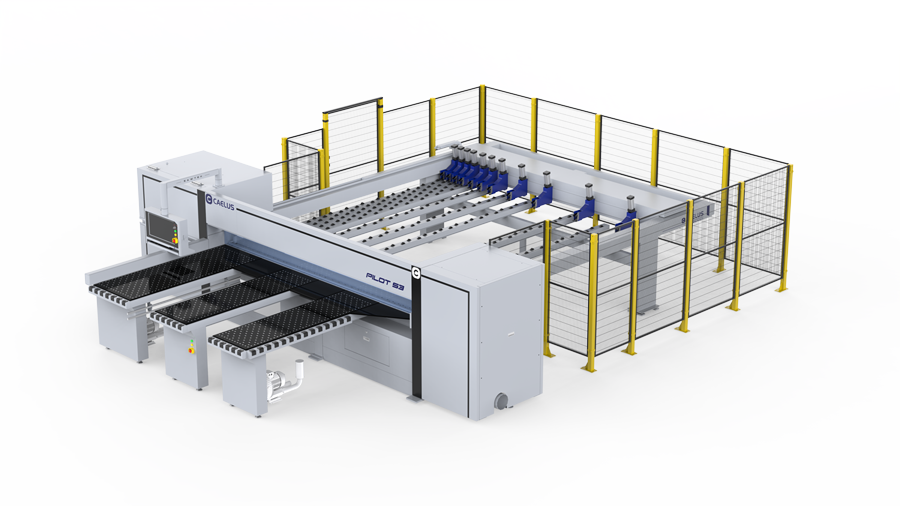
A CNC panel saw is usually the stronger choice when your factory needs fast, accurate breakdown of high volumes of rectangular panels and already has a reliable plan for downstream drilling and machining.
Choose a CNC panel saw first when:
- Most parts are standard rectangles, such as cabinet sides, shelves, backs, fillers, and toe kicks.
- The same panel sizes repeat across many orders.
- Your main bottleneck is straight cutting rather than drilling, grooving, or profile routing.
- You already use, or plan to add, suitable drilling and machining equipment after cutting.
- Your nesting router is spending too much time cutting simple parts that need no further machining.
- You need stable, clean cuts on faced panels before edge banding.
A main saw and scoring saw arrangement can help control chipping on laminated or melamine-faced panels. However, the saw is only one stage of the route. Its value depends on whether labelling, sorting, drilling, edge banding, and internal material flow can keep pace with its output.
When a CNC Router Is the Better Choice
A CNC nesting router is often the better starting point for cabinet factories that process custom, mixed, or frequently changing orders. Its value comes from combining several operations on one sheet before parts move to edge banding.
Choose a CNC router first when:
- Parts need face drilling, grooves, cutouts, or shaped profiles.
- Cabinet dimensions, part lists, and order sizes change frequently.
- Manual measuring, marking, and moving parts between machines cause delays or errors.
- You want to keep nesting, part machining, and labelling in one digital workflow.
- You have limited capacity for separate cutting, drilling, and routing stations.
- You can support the machine with suitable vacuum hold-down, tooling, dust extraction, software, and trained operators.
Not every CNC router has the same capability. Confirm whether the proposed configuration includes the drilling units, tool changer, vacuum system, labelling equipment, and software connection required for your actual parts.
Five Mistakes to Avoid Before Buying
1. Comparing only cutting speed:
A fast cutting cycle does not always mean faster cabinet production. Include drilling, sorting, labelling, part transfers, edge banding, and waiting time in the comparison.
2. Assuming every CNC router has the same functions:
A router may cut, drill, groove, label, or load automatically, but only if its configuration includes the required equipment and software. Confirm every required operation before comparing quotations.
3. Treating material yield as a fixed percentage:
Nesting can improve sheet use for mixed or shaped parts, while an optimized panel saw can be highly efficient for repeated rectangles. Test both methods with real cut lists, grain direction, tool kerf, and offcut policy.
4. Ignoring small-part and edge-quality control:
Router performance depends on vacuum hold-down, tooling, dust extraction, and small-part retention. Panel saw performance depends on blade condition, scoring setup, calibration, and material handling.
5. Buying without checking the next process:
A panel saw needs a clear route for drilling and machining. A router still needs edge banding and may need separate edge-hole processing. The machine must fit the whole line, not only the cutting department.
What to Prepare Before Requesting a Recommendation
A useful equipment recommendation starts with production data, not a general preference.
- Main materials, thicknesses, sheet sizes, and surface finishes
- Average daily or weekly sheet volume
- Percentage of rectangular, drilled, grooved, and shaped parts
- Typical order size and frequency of design changes
- Required hole types, grooves, and edge-machining operations
- Current machines, bottlenecks, operators, and available floor space
- Existing design, nesting, ERP, MES, or labelling software
- Plans for automatic loading, storage, sorting, or edge-banding integration
Use several representative orders, including standard jobs, custom jobs, and the parts that regularly create delays or rework.
FAQ
Q1. Is a CNC panel saw faster than a CNC router for cabinet production?
A: For repeated rectangular parts, a CNC panel saw is usually faster at straight cutting. A nesting router may take longer per sheet, but it can complete cutting, drilling, and grooving in one workflow. Compare total part-processing time, not cutting time alone.
Q2. Does a CNC panel saw need a drilling machine?
A: If parts need shelf-pin holes, hinge holes, connector holes, or grooves, they need a later machining process. Depending on the product and output target, this may be a drilling machine, a CNC six-sided drilling center, or another machining solution.
Q3. Which machine produces less material waste?
A: Neither machine always uses less material. Nesting can improve yield on mixed-size or shaped parts. A panel saw with optimized cutting patterns can be highly efficient for repeated rectangular parts. Test both methods with real production files.
Q4. When should a factory use both machines?
A: Use both when the router is occupied with simple rectangular parts while other parts need drilling, grooves, or profiles. The panel saw can handle straightforward cutting, while the router focuses on parts where machining adds greater value.
Conclusion
Choosing between a CNC panel saw and a CNC router depends on the work your cabinet parts require after cutting. A panel saw is the practical choice for fast, repeatable rectangular panels, while a nesting router suits custom parts that need drilling, grooves, or shaped profiles. The right decision also considers material flow, downstream drilling, edge banding, and labour. Many factories gain the best flow by using both: the saw for simple parts and the router for machining. Share your cut lists, materials, and output goals with Caelus to discuss a production setup that fits your workflow.