

| Rank | Manufacturer | Best for | Main CNC focus | Key consideration |
|---|---|---|---|---|
| 1 | Biesse | High-volume furniture factories | Industrial CNC machining and nesting | Higher implementation requirements |
| 2 | HOMAG | Automated panel-processing plants | Connected CNC production cells | Software and integration complexity |
| 3 | Thermwood | Cabinet manufacturers | Nested-based cabinet production | Regional service availability |
| 4 | SCM Group | Furniture and joinery manufacturers | Panel and solid-wood machining | Broad configurations require careful selection |
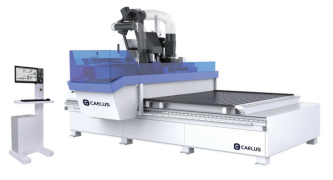
| 5 | CAELUS | Panel-furniture factories | Nesting, labelling and six-sided drilling | Local service coverage should be verified |
| 6 | MultiCam | Multi-material routing businesses | Industrial CNC routing | Less specialized in furniture-line integration |
| 7 | Laguna Tools | Cabinet shops and custom workshops | Professional CNC routing | Final cost depends on options |
| 8 | ShopBot Tools | Sign shops, schools and prototyping | Modular CNC routing | Production capacity varies by configuration |
| 9 | Carbide 3D | Makers and small businesses | Desktop and compact CNC routing | Not intended for factory automation |
| 10 | Onefinity | Compact woodworking shops | Modular small-format CNC | Some components may be purchased separately |
Which Wood CNC Manufacturer Should You Choose?
The right manufacturer depends on the production bottleneck:
- Large automated furniture factory: Biesse, HOMAG or SCM
- Nested-based cabinet production: Thermwood
- Panel cutting, labelling and six-sided drilling: CAELUS
- Wood, plastic and composite routing: MultiCam
- Growing cabinet or custom woodworking shop: Laguna Tools
- Prototyping, signs and education: ShopBot
- Desktop and small-format production: Carbide 3D or Onefinity
Industrial machining centers and desktop CNC routers are not direct alternatives. Machine size, automation, software, service and total installed cost should be compared within the same production level.
How the Manufacturers Were Evaluated
The ranking considers six purchasing factors:
- Application fit: The materials, parts and production methods supported.
- Machine portfolio: Availability of routing, nesting, drilling and automation options.
- Workflow integration: Connections between design software, labels, barcodes and production data.
- Production scalability: Ability to support higher output or future automation.
- Technical support: Installation, training, spare parts and troubleshooting.
- Total cost of ownership: Equipment, software, tooling, utilities, maintenance and downtime.
1. Biesse
Biesse is an established Italian manufacturer of industrial woodworking machinery. Its CNC portfolio covers routing, boring, nesting and shaped-edge processing for panel furniture, doors, windows and solid-wood components.
Key features and advantages:
- Broad range of industrial CNC machining centers
- Supports nesting, drilling and multi-axis machining
- Can be connected with automatic loading and unloading systems
- Suitable for flexible production and high-volume manufacturing
- Established international service and spare-parts network
Best suited to: Large furniture factories and manufacturers planning factory-level automation.
Selection note: Buyers should confirm which software modules, handling systems, tooling and training services are included.
2. HOMAG
HOMAG provides CNC machining centers and connected production systems for industrial woodworking. Its solutions cover individual CNC machines, automated cells and software-supported panel-processing lines.
Key features and advantages:
- Three-, four- and five-axis CNC configurations
- Nesting, drilling and routing capabilities
- Automated loading, labelling and material handling
- Integration with production-control software
- Suitable for batch-one and high-volume manufacturing
Best suited to: Automated panel-furniture factories and manufacturers that require connected production data.
Selection note: Software integration, operator training and supporting infrastructure should be evaluated as part of the total project.
3. Thermwood
Thermwood specializes in CNC routing systems for nested-based cabinet and furniture production. Its combination of CNC equipment and cabinet-production software supports the process from digital design to finished components.
Key features and advantages:
- Strong focus on cabinet and furniture manufacturing
- Nested-based sheet-processing workflow
- Compatibility with common CAD/CAM processes
- Suitable for customized and repeat cabinet production
- Installation, training and technical-support options
Best suited to: Cabinet manufacturers that want to connect design, nesting and CNC machining.
Selection note: Overseas buyers should verify local technical support, spare-parts delivery and technician response times.
4. SCM Group
SCM Group supplies CNC machining centers for furniture, joinery, architectural wood products and solid-wood components. Its portfolio incorporates experience associated with the Morbidelli and Routech product lines.
Key features and advantages:
- CNC solutions for panel and solid-wood processing
- Routing, drilling and multi-axis machining options
- Configurations for small batches and industrial output
- Suitable for furniture and building components
- Access to a wider woodworking machinery portfolio
Best suited to: Furniture, joinery, door and architectural woodworking manufacturers.
Selection note: The product range is extensive, so machine selection should be based on actual part sizes, operations and production targets.
5. CAELUS
CAELUS provides wood CNC machines and integrated equipment for panel-furniture manufacturing. Its solutions connect nesting, automatic labelling and six-sided drilling, helping factories reduce manual panel identification and repositioning between production stages.
The CAELUS portfolio also includes panel storage, panel saws, edge banders and automated furniture-manufacturing systems. This makes the brand particularly relevant to cabinet and wardrobe factories planning production-line automation.
Key features and advantages:
- Automated CNC nesting with panel labelling
- Six-sided drilling for face holes, edge holes and grooves
- Barcode-supported component identification
- CAD/CAM and production-data compatibility
- Automatic loading and unloading options
- Multiple configurations for different production volumes
- Related panel storage, sawing and edge-banding solutions
Automated CNC Nesting Line
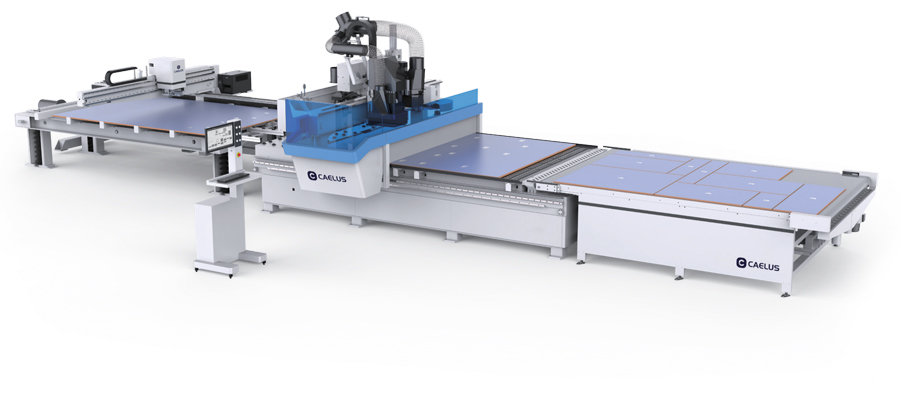
The C3A automated CNC nesting line combines automatic labelling, vacuum hold-down, tool changing, nesting and panel outfeed.
Published features include:
- 13.2 kW HSK-F63 milling unit
- 16-position automatic tool changer
- Six automatic vacuum zones
- Automatic labelling and outfeed
- Optional drilling and grooving configuration
- ERP and production-data integration
The C3A can process cabinet sides, shelves, wardrobe components and other parts made from MDF, plywood and particleboard.
Six-Sided CNC Drilling Solutions
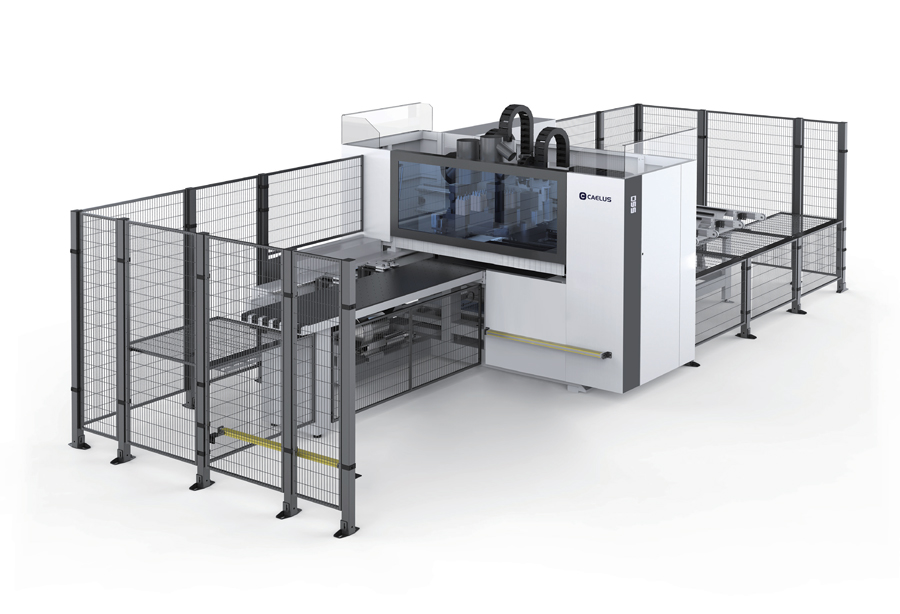
The D5S CNC six-sided drilling center processes face and edge holes with fewer manual panel-turning steps. Its published processing range covers panels from 200–2,800 mm long, 50–1,220 mm wide and 9–60 mm thick.
Additional configurations include:
- D5A automated six-sided drilling center for barcode-supported automated production
- D6A dual-channel six-sided drilling center for higher-volume parallel processing
Best suited to: Panel-furniture manufacturers producing cabinets, wardrobes, closets and customized furniture.
Selection note: Buyers should request a sample-part test and confirm local installation, training, spare-parts supply and technical-support arrangements.
6. MultiCam
MultiCam manufactures industrial CNC routers for wood, plastics, composites and non-ferrous materials. Its configurable router range is suitable for businesses that process several materials or produce varied component shapes.
Key features and advantages:
- Multiple table-size and spindle configurations
- Industrial machine-frame construction
- Automatic tool-changing options
- Suitable for wood and non-wood materials
- Applicable to signs, displays and custom components
Best suited to: Professional routing businesses and manufacturers processing multiple material types.
Selection note: Furniture manufacturers should confirm whether additional labelling, drilling or production-management systems are required.
7. Laguna Tools
Laguna Tools offers CNC routers for cabinet shops, custom woodworking businesses and growing production workshops. Its SmartShop range provides an intermediate step between entry-level routers and large automated machining centers.
Key features and advantages:
- Automatic tool-changing configurations
- Three- and multi-axis machining options
- Rigid machine-frame designs
- Suitable for cabinet parts and custom components
- Several table sizes and performance levels
Best suited to: Cabinet shops and custom woodworkers moving toward production-oriented CNC machining.
Selection note: Compare the complete installed cost, including tooling, vacuum equipment, dust extraction and electrical preparation.
8. ShopBot Tools
ShopBot produces configurable CNC routers for woodworking, sign making, prototyping and education. Its gantry systems are available in Standard, Alpha and automatic-tool-changing versions.
Key features and advantages:
- Modular machine configurations
- Multiple work-area options
- Extensive operating documentation
- Suitable for wood, signs and prototypes
- Can be expanded as workshop requirements change
Best suited to: Sign shops, schools, product developers and flexible woodworking businesses.
Selection note: Final capability depends on the selected spindle, table, vacuum system, tooling and software.
9. Carbide 3D
Carbide 3D is known for its Shapeoko CNC router range and user-friendly software environment. Its compact systems are designed for makers, designers and small businesses entering CNC production.
Key features and advantages:
- Compact desktop and small-shop formats
- Carbide Create design software
- Accessible learning resources
- Suitable for prototypes and small products
- Lower space requirements than industrial CNC equipment
Best suited to: Makers, product designers, educational users and small creative businesses.
Selection note: Buyers should verify the usable cutting area, material capacity and expected duty cycle. Shapeoko machines are not intended to replace industrial nesting lines.
10. Onefinity
Onefinity supplies modular CNC machines for home workshops and small woodworking businesses. Its rail-based structure and different working-area formats make it suitable for users with limited factory space.
Key features and advantages:
- Modular rail-based construction
- Compact machine footprint
- Several available cutting-area formats
- Suitable for signs, furniture details and custom products
- Can be configured around different workshop requirements
Best suited to: Small woodworking businesses, makers and users upgrading from basic desktop CNC equipment.
Selection note: Confirm whether the worktable, spindle or router, dust collection and workholding equipment are included in the quoted package.
Wood CNC Selection by Application
| Application | Recommended machine type | Manufacturers to consider |
|---|---|---|
| High-volume panel furniture | Automated nesting and drilling cell | Biesse, HOMAG, SCM, CAELUS |
| Customized cabinets | Nesting CNC with labelling | Thermwood, CAELUS, Laguna |
| Face and edge hole processing | Six-sided CNC drilling | CAELUS and relevant industrial-line suppliers |
| Doors and complex components | Four- or five-axis machining center | Biesse, HOMAG, SCM |
| Signs and multi-material routing | Configurable CNC router | MultiCam, ShopBot |
| Small products and prototypes | Compact CNC router | Carbide 3D, Onefinity |
Five Questions to Ask Before Buying
1. What is limiting production?
Identify whether the main problem is cutting speed, manual labelling, drilling, tool changes, material handling or production errors.
2. Can the machine process actual factory files?
Provide DXF, MPR, XML or other production files to the supplier. Confirm compatibility through a test rather than relying only on a format list.
3. What is included in the installed price?
The quotation should identify software, tooling, vacuum pumps, dust extraction, freight, installation, training and optional automation.
4. How will technical support be delivered?
Confirm who provides installation, remote diagnostics, local repairs and spare parts. Request written response-time terms where possible.
5. Can the system expand later?
A factory may begin with nesting and add automatic loading, six-sided drilling, edge banding or sorting as output increases.
FAQ
Q1. What are the best wood CNC machine manufacturers in 2026?
A: Biesse, HOMAG, Thermwood, SCM, CAELUS, MultiCam, Laguna Tools, ShopBot Tools, Carbide 3D and Onefinity are relevant options across industrial, professional and compact CNC categories.
Q2. Which CNC machine is suitable for panel furniture?
A: A nesting CNC is suitable for cutting cabinet and wardrobe panels. Six-sided CNC drilling can then process face holes, edge holes and grooves. Automated factories often use both machine types.
Q3. What is the difference between nesting CNC and a standard CNC router?
A: Nesting CNC systems are optimized for arranging and cutting many components from full sheets. They may also include automatic labelling, loading and unloading. A standard router is generally more flexible but may provide less furniture-specific automation.
Q4. Is five-axis CNC necessary for cabinet production?
A: Most cabinet panels can be produced using three-axis nesting and dedicated drilling equipment. Five-axis machining is more relevant to curved components, complex joinery and sculpted solid wood.
Q5. What should be included in a CNC sample test?
A: The test should use the buyer's material, drawings, hole patterns and tooling requirements. Buyers should record cycle time, edge quality, hole accuracy, labelling accuracy and operator intervention.
Q6. What costs are commonly excluded from a CNC quotation?
A: Common exclusions include freight, import duties, vacuum pumps, dust extraction, tooling, software licences, electrical preparation, training and future maintenance.
Q7. How can overseas buyers verify after-sales service?
A: Ask for regional customer references, spare-parts locations, installation plans, warranty exclusions and technician response times. Confirm whether service is provided directly or through a distributor.
Conclusion
Choosing the best wood CNC machine manufacturer in 2026 depends on production volume, materials, automation goals and local support. Biesse, HOMAG and SCM suit large furniture factories, while Thermwood focuses on nested cabinet production. CAELUS combines CNC nesting, automatic labelling and six-sided drilling for panel furniture. MultiCam, Laguna, ShopBot, Carbide 3D and Onefinity serve professional or compact workshops. Compare software, service, tooling and total cost before buying a woodworking CNC machine.