

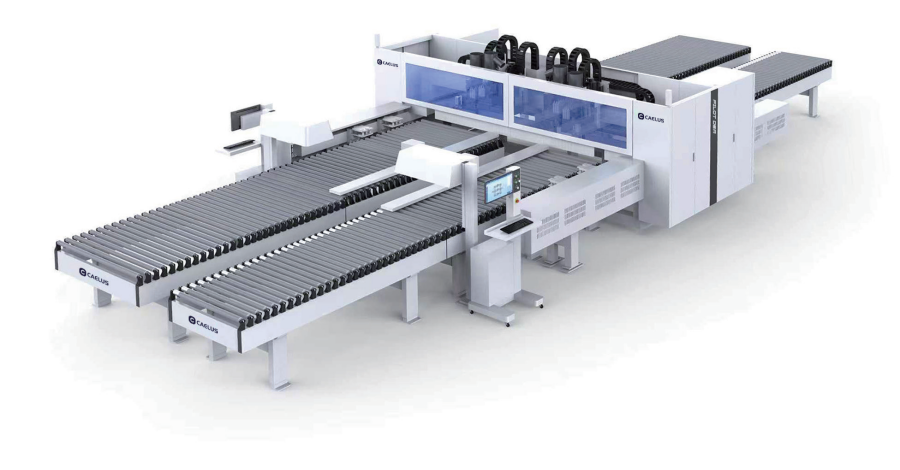
Choosing between a CNC nesting machine and a CNC 6-sided drilling machine becomes easier when you look at what enters each machine and where work waits in your factory.
Quick answer:
- Choose nesting when full-sheet cutting, layout optimization, labeling, or part sorting is the constraint.
- Choose six-sided drilling when edge holes, panel flipping, drilling queues, or assembly mismatches are the constraint.
- Consider both when cutting and drilling are recurring bottlenecks in the same panel furniture line.
Where These Machines Fit Among Wood CNC Machine Types
Not every wood CNC machine serves the same work. A standard CNC router suits general cutting, carving, and one-off parts. A PTP machining center processes individual components with flexible drilling and routing. A nesting machine converts full sheets into labeled parts. A six-sided drill completes repeated face and edge holes on pre-cut panels.
For panel furniture production, the last two often form connected stages rather than competing alternatives.
CNC Nesting Machine vs. CNC 6-Sided Drilling Machine at a Glance
| Comparison | CNC Nesting Machine | CNC 6-Sided Drilling Machine |
|---|---|---|
| Starting material | Full MDF, plywood, or particleboard sheet | Individual pre-cut panel |
| Main purpose | Layout optimization, cutting, routing, grooving, labeling | Face and edge drilling, grooving, connector machining |
| Workholding | Vacuum table and spoilboard | Automatic clamps or grippers with panel support |
| Irregular profiles | Well suited | Usually not the main application |
| Top-face holes | Supported according to machine configuration | Core function |
| Horizontal edge holes | Configuration dependent | Core function |
| Part identification | Label is created or applied | Barcode is scanned to call the correct program |
| Main bottleneck addressed | Cutting, sheet use, sorting, part identification | Drilling queues, panel flipping, positioning errors |
| Typical next stage | Edge banding, drilling, sorting | Sorting and assembly |
Start With the Part, Not the Specification Sheet
Imagine a cabinet side that needs an outside profile, shelf-pin holes, a back-panel groove, connector holes, and horizontal holes along one edge.
The nesting machine cuts its profile and supported top-face features, then creates a part label. The six-sided drill reads that identity and completes the face and edge holes with less manual turning.
A nesting spindle can drill holes, but a dense pattern may consume cutting capacity. Base the decision on everyday parts, not the longest feature list.
What a CNC Nesting Machine Does Best
A nesting CNC converts full sheets into identified furniture components. Production data is imported from design or CAM software, parts are arranged within the available sheet, and toolpaths are generated for cutting and machining.
Its value is wider than cutting speed. A nesting workflow can:
- reduce avoidable offcut through optimized layouts
- process mixed sizes and shaped profiles
- route grooves and perform supported vertical drilling
- connect parts to orders through labels
- prepare parts for downstream processing
Material yield should not be advertised as one fixed percentage. It changes with part geometry, quantities, grain direction, trim allowance, tool diameter, spacing, and whether useful offcuts are returned to inventory.
The credible way to compare systems is to run the same order file, sheet size, and material rules through each nesting setup.
The CAELUS C3LA combines nesting, grooving, drilling, labeling, and outfeed with a 13.2 kW HSK-F63 spindle, a 16-position tool changer, and six vacuum zones. Its full-line panel range reaches 4,200 by 2,100 mm with thicknesses from 10 to 25 mm.
The CAELUS C3A adds an optional unit with 12 vertical spindles, 8 horizontal spindles, and a grooving saw. Its labeling section accepts panels up to 3,100 by 2,100 mm and 10 to 40 mm thick.
Loading capacity is 3,500 kg and conveyor speed reaches 14 m/min. Finished-part output still depends on the nest, toolpath, labeling, and downstream capacity.
What a CNC 6-Sided Drilling Machine Does Best
A six-sided drilling machine receives an individual panel, identifies the program, positions the workpiece, and completes programmed holes on its broad faces and edges.
Six-sided describes the accessible surfaces. It does not mean every surface is drilled at the same instant.
It suits cabinet sides, shelves, partitions, drawers, wardrobes, and flat-pack parts containing:
- hinge holes
- dowel holes
- connector holes
- blind holes
- through holes
- horizontal edge holes
The CAELUS D5S supports panels from 200 to 2,800 mm long, 50 to 1,220 mm wide, and 9 to 60 mm thick.
Two upper drilling blocks provide 26 vertical and 18 horizontal positions, with 9 vertical positions below. Maximum drill diameter is 35 mm and processing depth is 45 mm.
The CAELUS D5A uses a 2 plus 1 drilling-head arrangement with 53 tools, barcode scanning, and front-in, rear-out flow.
It handles panels from 200 to 2,800 mm long, 50 to 1,220 mm wide, and 10 to 60 mm thick. Published positioning tolerance is no more than 0.3 mm under stated panel conditions.
For higher demand, the CAELUS D6A uses dual channels and six coordinated drilling heads.
Test the real mix of wide and narrow parts because the published left-channel width reaches 1,220 mm, while the right channel reaches 800 mm.
Which Machine Should You Buy First?
| Your Current Constraint | Starting Point |
|---|---|
| Manual cutting, poor sheet use, shaped parts, or missing labels | CNC nesting machine |
| Reliable cutting but slow edge drilling, panel flipping, or assembly mismatches | CNC 6-sided drilling machine |
| Work queues at both cutting and drilling | Connected nesting and drilling solution |
A practical flow is:
- Design
- Nesting optimization
- Automatic labeling
- Cutting and routing
- Edge banding
- Barcode scanning
- Six-sided drilling
- Sorting
- Assembly
Confirm the exact sequence against your reference edges, hardware, and construction method.
Common Buying Mistakes
| Mistake | Better Check |
|---|---|
| Comparing spindle power only | Test actual parts and required operations |
| Treating every listed function as equally productive | Time a real order with normal tools and material |
| Automating one isolated station | Check edge banding, drilling, sorting, and assembly capacity |
| Ignoring software | Verify formats, post-processing, barcode fields, error handling, and ERP ownership |
| Comparing purchase price only | Include tooling, software, training, installation, utilities, maintenance, and downtime |
Questions to Prepare Before Requesting a Quote
Prepare the following information:
- material types and sheet sizes
- panel thickness range
- smallest and largest finished parts
- typical hole patterns
- required output per shift
- existing machines
- current design and production software
- factory layout and available space
- electrical, air, and dust-extraction conditions
- future expansion plans
Include two or three actual drawings. They provide more useful information than a general product description.
CAELUS can compare a nesting-only setup, standalone six-sided drilling, or a connected solution. The goal is to remove the next measurable constraint without creating a new one downstream.
FAQ
Q1. What is the main difference between a CNC nesting machine and a CNC 6-sided drilling machine?
A: A nesting machine converts full sheets into labeled parts. A six-sided drill starts with pre-cut parts and concentrates on top, bottom, and edge holes.
Q2. Can a CNC nesting machine drill horizontal holes?
A: Some configurations support horizontal drilling, but access, workholding, panel geometry, and cycle time must be checked. A six-sided drill is generally better for repeated multi-face work.
Q3. Can a nesting CNC replace a six-sided drilling machine?
A: It may be enough for low or moderate volume with few edge holes. It is less suitable when dense horizontal holes, repeated panel flipping, or drilling queues consume cutting capacity.
Q4. Do all furniture factories need both machines?
A: No. A smaller shop may begin with nesting, while a factory with reliable cutting but slow drilling may invest in six-sided drilling first. Both become valuable when cutting and drilling are recurring constraints.
Q5. Should edge banding come before six-sided drilling?
A: Often it does in an integrated cabinet workflow, but the correct sequence depends on reference edges, exposed surfaces, hardware, and construction method. Confirm it using actual parts before fixing the layout.
Q6. What software is needed to connect nesting and drilling?
A: The workflow needs CAD/CAM, a compatible post-processor, nesting software, and shared barcode data. Verify formats, field mapping, version control, and scan-error handling.
Q7. What determines actual production capacity?
A: Panel dimensions, hole count, nest complexity, tool changes, material handling, labeling, sorting, operator practices, and downstream equipment all affect capacity. A timed test using real order data is more useful than a maximum-speed figure.
Q8. What should I send CAELUS for a machine recommendation?
A: Send representative panel drawings, materials, dimensions, hole details, daily or shift output, current software, existing equipment, factory layout, and the production problem you want to solve.
Conclusion
Choosing between a CNC nesting machine and a CNC 6-sided drilling machine starts with your bottleneck. Nesting turns full sheets into cut, labeled parts and addresses slow cutting, poor layouts, or sorting. Six-sided drilling processes pre-cut panels and repeated face and edge holes when drilling queues or panel turning delay assembly. If both stages fall behind, connect them through shared part data. Test actual orders and downstream capacity before investing in either wood CNC machine type.