

Quick Answer
A wood CNC machine is a computer controlled system that cuts, drills, routes, grooves or shapes wood from digital instructions. CAD software defines the part, CAM software creates toolpaths, and the controller moves cutting or drilling units along programmed axes.
The term covers more than CNC routers. It also includes nesting machines, six sided drilling centers, multi axis machining centers and CNC lathes. The right type depends on the workpiece and production bottleneck.
At a Glance
- Common materials: Solid wood, MDF, plywood, particleboard and veneered panels
- Common operations: Cutting, routing, drilling, grooving, carving and labelling
- Main selection question: Which process is delaying the next production step?
What Does CNC Mean in Woodworking?
CNC stands for Computer Numerical Control. Instead of an operator guiding every cut, the machine follows digital coordinates, tool instructions and speed settings.
A three axis machine moves in X, Y and Z directions. A fourth rotary axis supports cylindrical parts. Five axis equipment lets a tool approach complex components from several angles.
Axis count is only one part of the decision. A three axis nesting machine may be more useful to a cabinet factory than a five axis machine if most products are flat panels.
How Does a Wood CNC Machine Work?
Most jobs follow six steps:
- Create or import a CAD drawing: This defines part sizes, contours, holes and grooves.
- Build toolpaths in CAM software: Select the cutter, depth, feed setting and machining order.
- Convert the job into machine instructions: The controller may use G code or compatible DXF, MPR or XML files.
- Position and hold the material: Vacuum zones are common for panels, while smaller parts may require mechanical clamps.
- Run the program: The controller coordinates the spindle, drills, tool changer and movement axes.
- Inspect and identify the part: Labels can connect panels to edge banding, drilling, sorting and assembly.
A correct program does not guarantee a correct part. Tool condition, vacuum strength, panel flatness and machine calibration still affect the result.
Types of Wood CNC Machines
| Machine type | Typical input | Main work | Suitable applications |
|---|---|---|---|
| CNC router | Sheet or individual blank | Routing, cutting and engraving | Signs, doors and general woodworking |
| CNC nesting machine | Full size panel | Nesting, cutting, drilling and labelling | Cabinets, wardrobes and mixed orders |
| Six sided drilling center | Cut furniture panel | Vertical and horizontal holes, grooves | Cabinet sides, shelves and doors |
| Four or five axis center | Shaped or solid wood blank | Multi face and three dimensional machining | Curved parts and complex joinery |
| CNC wood lathe | Solid wood blank | Rotational shaping | Table legs, columns and balusters |
| Laser machine | Thin sheet | Thermal cutting and engraving | Signs and decorative products |
A laser follows digital coordinates but removes material with heat. Its edge finish, thickness range, fumes and fire controls differ from spindle based equipment.
What Parts Affect the Result?
The frame and motion system support stable movement. The spindle or drilling unit performs the machining, while the controller interprets the program.
Other important systems include:
- Tool changers that reduce manual stops
- Vacuum zones or clamps that prevent movement
- Spoilboards that support sheet cutting
- Dust extraction that removes chips
- Software and barcode systems that connect parts to orders
Where Does a Wood CNC Machine Fit in a Furniture Factory?
| Production problem | Equipment to evaluate | Reason |
|---|---|---|
| Full sheets wait for cutting | CNC nesting machine or panel saw | Both begin with sheet material |
| Parts lose their order identity | Nesting with automatic labelling | Labels connect parts to downstream data |
| Cut panels wait for side holes | Six sided drilling center | It processes several faces with less turning |
| Products have curved solid wood surfaces | Four or five axis center | The tool can approach complex geometry |
| Only straight cuts are required in volume | Panel saw | A router may add unnecessary complexity |
A Practical Look at CAELUS Wood CNC Machines
CAELUS focuses its wood CNC machine range on panel furniture workflows.
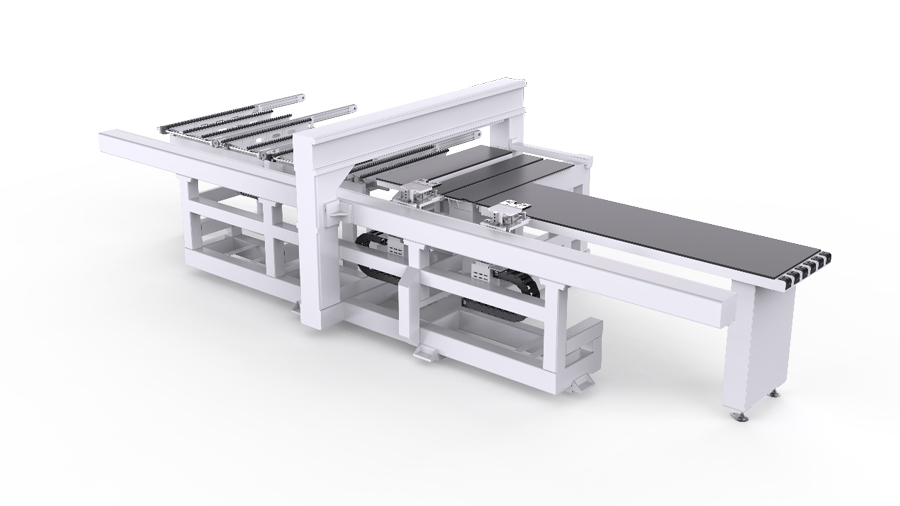
The C3LA CNC nesting line combines loading and labelling with drilling, grooving, cutting and outfeed.
Its published configuration includes:
- 13.2 kW HSK F63 spindle
- 16 position automatic tool changer
- Six automatically controlled vacuum zones
- Maximum listed panel size of 4,200 by 2,100 mm
- Published panel thickness range of 10 to 25 mm
This configuration is intended for factories that start with full sheets and produce mixed cabinet or wardrobe parts.
For downstream drilling, the D5S six sided drilling center lists:
- Panel length from 200 to 2,800 mm
- Panel width from 50 to 1,220 mm
- Panel thickness from 9 to 60 mm
- Two upper drilling blocks with 26 vertical and 18 horizontal positions
- One lower block with nine vertical positions
- Maximum drill diameter of 35 mm
- Maximum processing depth of 45 mm
These figures define the operating range. They do not establish daily output because production also depends on the workpiece, program, handling and connected processes.
What Should You Check Before Buying?
Prepare the following information before requesting a machine configuration:
- Materials and thicknesses
- Largest and smallest workpieces
- Typical hole and groove patterns
- Orders or panels per shift
- Existing CAD, CAM, ERP or MES software
- Available floor space
- Electrical, compressed air and extraction capacity
- Current production bottleneck
Utilities should be checked against the selected configuration.
D5A automated drilling solution, for example, lists 0.6 MPa working pressure, air consumption of 450 litres per minute and dust extraction volume of 9,540 cubic metres per hour.
Common Misunderstandings
More axes mean a better machine: More axes expand possible movements, but may not improve flat panel production.
CNC machines do not need operators: Operators still manage programs, tools, materials, inspection, maintenance and safe fault recovery.
The largest spindle gives the highest output: Output also depends on toolpaths, work holding, loading, tool changes and downstream flow.
File compatibility means full integration: Compatibility should be tested with an actual order, label and machine program.
FAQ
Q1. Is a wood CNC machine the same as a CNC router?
A: No. A CNC router is one type within the wider wood CNC machine category.
Q2. Which materials can it process?
A: Common materials include solid wood, MDF, plywood, particleboard and veneered panels. Suitability depends on tooling, thickness, density, surface finish and work holding.
Q3. Which machine suits cabinet production?
A: Evaluate CNC nesting when full sheet cutting, labelling and part tracking are the main needs. Evaluate six sided drilling when multi face holes and repeated panel turning cause the production queue.
Q4. How accurate is a wood CNC machine?
A: There is no single accuracy figure for the entire category. Results depend on machine configuration, calibration, tooling, material, work holding, program and measurement method.
Request a documented test using your material and representative part.
Conclusion
A wood CNC machine is a computer controlled system that turns CAD and CAM data into repeatable cutting, drilling, routing and grooving operations. The right machine depends on workpiece and the production bottleneck. CNC nesting suits full sheet cutting, labelling and mixed cabinet orders, while six sided drilling supports multi face hole processing on cut panels. Before choosing a model, check materials, part sizes, software, utilities, safety needs and a documented test using production files.