

In modern panel processing and automated furniture manufacturing workshops, if there is one element that serves as the "backbone" supporting the entire production capacity, it is undoubtedly the core cutting equipment. When faced with mountains of orders and nearly uncompromising demands for dimensional precision, traditional sliding table saws have long since proven inadequate; the industry has ushered in the era of the beam saw.
However, when factory owners approach the task of upgrading their equipment with a budget in hand, they often find themselves bewildered. Different types of beam saws vary drastically in terms of mechanical structure, cutting precision, production efficiency, and level of automation. Investing in a machine that is too small creates production bottlenecks; investing in one that is too large results in extremely inefficient capital utilization. This is not merely a simple act of "buying a saw," but rather a strategic exercise in planning the factory's profit model for the next five years.
This brings us to a core question that every decision-maker intending to upgrade equipment must confront: What exactly are the different types of beam saws? Amidst a complex and crowded market, which specific type is best suited to your current production needs and future automation plans? This article aims to cut through the confusion and provide you with a comprehensive, in-depth guide to selecting the right equipment.
What is a Beam Saw?
To understand the beam saw, we must first begin with the definition of a panel saw.
Panel Saw Definition
Simply put, a panel saw is a piece of mechanical equipment specifically designed for making straight-line cuts on large-format sheet materials—such as wood panels, MDF, chipboard, and even plastics or aluminum. It is most commonly found in the woodworking industry and furniture manufacturing workshops.
Definition of a Beam Saw
You can think of a beam saw as the "ultimate industrial evolution" of the standard panel saw. Its defining characteristic is the presence of a heavy, robust pressure beam. At the precise moment the saw blade executes a high-speed cut, this pressure beam clamps down firmly on the material—much like a hydraulic vise—eliminating even the slightest vibration or shifting. This structural design endows the machine with unparalleled precision, making it widely adopted in the demanding field of CNC panel processing.
The Relationship Between Beam Saws and CNC Machines
Modern CNC beam saws are, without question, a specific category of CNC (Computer Numerical Control) machine tools. It completely eliminates reliance on operator eyesight and manual feel, instead utilizing a computer numerical control (CNC) system to precisely orchestrate the movement of clamps and the operation of the saw carriage, thereby truly realizing data-driven manufacturing.
An In-Depth Analysis of Different Types of Beam Saws
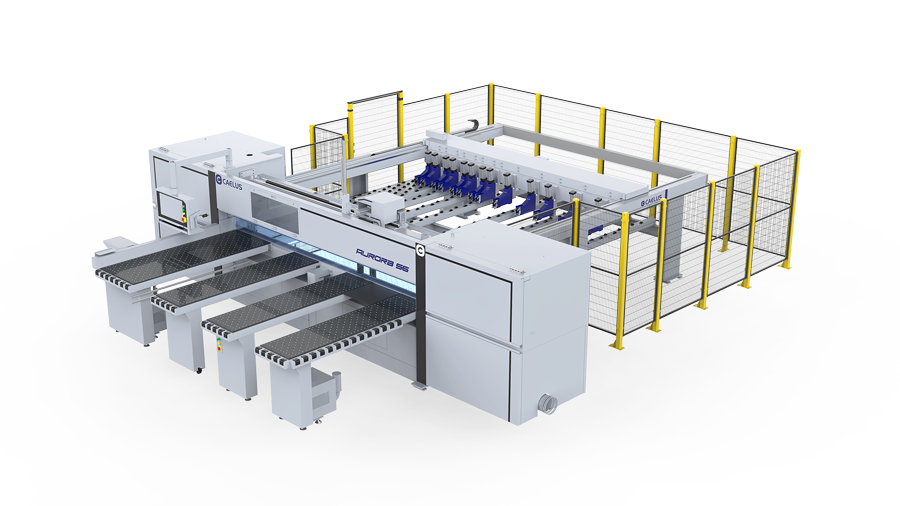
Although collectively referred to as "beam saws," they can be categorized into several distinct types based on their application scenarios and structural designs.
Transversal Beam Saws
When it comes to processing extremely large orders, transversal beam saws reign supreme.
• Features: These machines are typically paired with longitudinal cutting saws to form an "Angular Plant" configuration. First, the panels undergo longitudinal cutting; the resulting strips are then automatically transferred to the transversal beam saws for high-speed cross-cutting.
• Applications: This type of equipment is designed specifically for large-scale, standardized furniture manufacturing (such as furniture for long-term rental apartments or basic office desk panels), enabling an astonishing panel throughput in the shortest possible time.
CNC Beam Saws
These currently serve as the workhorse for medium-to-large-scale custom furniture manufacturers.
• Features: This represents a perfect extension of the "CNC panel saw" concept. Equipped with a powerful industrial PC, it can read and interpret complex cutting lists, automatically generating the optimal cutting layout (Nesting).
• Advantages: It pushes material utilization to its absolute limit, significantly reduces errors associated with manual material calculation, and ensures an exceptionally high degree of cutting consistency.
Automatic Beam Saws
These machines minimize human intervention to the greatest extent possible.
• Features: In addition to possessing full CNC capabilities, they integrate automated loading, pneumatic clamping and pushing systems, automated cutting cycles, and automatic waste removal systems.
• Applications: They serve as the core unit for establishing unmanned, automated production lines and for high-end panel processing operations.
Rear-Loading vs. Front-Loading Beam Saws
This classification is based on the physical structure of the machine relative to the factory layout.
• Front-Loading: Operators or forklifts load panels onto the worktable from the front of the machine. This configuration is suitable for factories with limited floor space or those performing single-sheet or small-batch cutting operations.
• Rear Loading: The rear of the machine is equipped with a lift table, allowing for the direct placement of entire stacks of panels; the machine then automatically picks up the panels layer by layer. This is the standard configuration for high-volume, continuous production.
Flexible Cutting Cell
This represents the pinnacle of cutting technology.
• Features: It is not merely a saw, but an intelligent, interconnected "island" comprising multiple synchronized devices. It is typically deeply integrated with intelligent panel storage systems and robotic arms.
• Status: It serves as the hallmark of advanced Automated Furniture Manufacturing, capable of perfectly handling the highly fragmented, "one-customer-one-order" style of custom production.
Beam Saw vs. Panel Saw: What Are the Core Differences?
Buyers upgrading their equipment for the first time often confuse these two concepts. Let's examine their fundamental differences.
Structural Differences
Standard panel saws (such as precision sliding table saws) rely primarily on manual force or simple mechanical propulsion to feed the material, resulting in relatively loose panel fixation. In contrast, the beam structure of a beam saw provides absolutely rigid clamping; this serves as the physical prerequisite for achieving micron-level precision and chip-free cutting.
The Automation Divide
High-end CNC panel saws or beam saws boast extremely high levels of automation, to the point where the operator need not even touch the wooden panels. Conversely, standard panel saws are labor-intensive machines; their low level of automation makes it difficult for them to integrate into modern digital data workflows.
Table 1: Equipment Selection by Factory Scale
|
Equipment Type |
Suitable Factory Scale |
Key Advantage |
Production Rhythm |
|
Traditional Panel Saw |
Small workshops / Prototyping |
Low initial cost, highly flexible |
Manual, slow |
|
CNC Panel Saw |
Medium custom shops |
High precision, data-driven |
Semi-auto, consistent |
|
CNC Beam Saw |
Medium to Large scale |
Stack cutting, optimized nesting |
Fast, high volume |
Applications of Different Beam Saw Types in Panel Processing
Choosing the right tool is essential for getting the job done right.
Large-Scale Standardized Production
If you are engaged in export-oriented project orders—processing panels of identical dimensions on a daily basis—then transversal beam saws equipped with rear-loading capabilities, or large-scale angular cutting saws, are your guarantee for high-capacity output.
Personalized Custom Furniture Production
When faced with wardrobes and cabinetry of constantly varying dimensions, a CNC beam saw—paired with intelligent optimization software—can minimize material waste. Furthermore, its front-loading design makes it convenient for workers to handle urgent, last-minute orders whenever necessary.
Automated Production Lines
When your objective is to reduce the number of manual laborers on the shop floor,
combining an automatic beam saw with a robotic arm—equipped with an automated sorting system at the backend—is the essential path to achieving continuous CNC panel processing.
How to Choose the Right Type of Beam Saw?
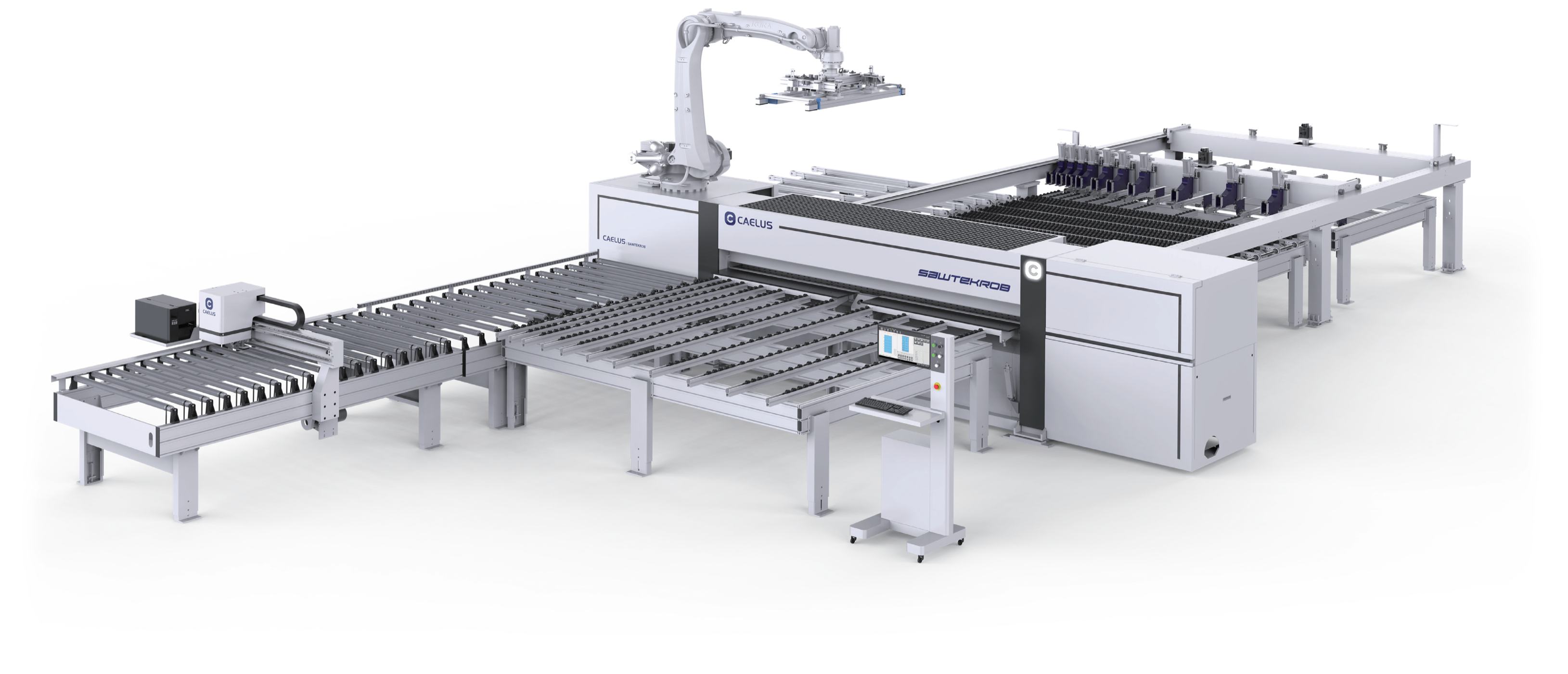
Panel Saw & Beam Saw SawTekRob 5
Investing in a panel cutting saw often entails a cost ranging from hundreds of thousands to over a million; therefore, the decision must be grounded in rational data analysis.
Tailoring the Solution to Production Scale
Do not overinvest merely for the sake of acquiring high-end equipment. Small workshops looking to upgrade might first consider an advanced panel saw featuring CNC-controlled fences; medium-sized custom manufacturing plants should decisively transition into the realm of CNC panel saws; meanwhile, large-scale factories producing over a hundred sets of furniture daily must be equipped with an automatic beam saw.
Evaluating Long-Term Automation Strategies
Will the saw you purchase today be able to communicate with your automated storage system tomorrow? When making a purchase, you must verify whether the equipment possesses the underlying protocol interfaces necessary to integrate with your workshop's MES (Manufacturing Execution System) and other CNC machines. In this regard, Caelus—an expert in smart furniture production line solutions—demonstrates a highly forward-looking product portfolio.
Taking Caelus's product matrix as an example: its Aurora series (a high-performance, highly automated panel saw) is engineered specifically for industrial-grade environments that demand extreme speed and high throughput, while the SawTekRob 5 represents an even more advanced solution—a flexible cutting cell featuring integrated robotic handling capabilities. Choosing a comprehensive line supplier like Caelus ensures that your equipment will never become an isolated "information silo."
Matching Features to Product Types
Cutting thick, solid wood places entirely different power demands on a machine compared to cutting thin panels. If you are producing standard furniture, prioritize equipment with robust heavy-duty stack-cutting capabilities; if you specialize in high-end custom manufacturing, focus instead on technologies that prevent edge chipping (via the main and scoring saw blades) and software capabilities that facilitate optimized nesting for irregular shapes.
The Evolution of Beam Saws in Automated Furniture Manufacturing
Driven by rapid technological advancements, cutting equipment is currently undergoing a profound transformation—evolving from mere "mechanization" into true "intelligent automation."
Deep Integration within Automated Production Lines
In the future, the beam saw will no longer operate in isolation; instead, it will establish dual connectivity—spanning both physical linkages and data exchange—with the *storage system* at the front end and the *edge banding* equipment at the back end. From warehouse to edge banding, sheet materials achieve high-speed circulation with a "no-floor-contact" workflow.
AI-Driven Intelligent Layout System
The pace of software evolution is now surpassing even that of hardware. AI is set to intervene in the layout planning phase; beyond merely considering material savings, it will integrate data on the processing load of downstream operations to optimize both material utilization and processing path planning.
Moving Toward Unmanned Factories
"Dark factories"—facilities operating automatically around the clock—are becoming a reality. Highly stable, automated cutting equipment serves as the core engine for realizing this vision.
FAQ
Q1: What are the different types of beam saws?
These primarily include transversal beam saws (designed for extremely high-efficiency mass production), CNC beam saws (controlled by computer programs), and automatic beam saws (featuring integrated automatic loading and unloading systems); additionally, there are models with front-loading or rear-loading configurations to suit various factory layouts.
Q2: What is the difference between a beam saw and a panel saw?
The most fundamental difference lies in their structural design and clamping mechanisms. A beam saw relies on a heavy-duty pressure beam to firmly clamp the material for high-precision cutting, and is frequently used for processing stacked batches of panels; a *panel saw* (or sliding table saw), conversely, relies primarily on manual pushing and is typically used for cutting single sheets.
Q3: What is a CNC beam saw?
It is an electronic panel-cutting saw driven by a Computer Numerical Control (CNC) system. The operator simply needs to input or import a cutting list, and the machine will automatically adjust the cutting path and pushing dimensions to execute the cutting process.
Q4: Which beam saw is best for furniture manufacturing?
This depends on the type of production. For large-volume standard orders, a large-scale automatic beam saw (specifically a rear-loading model) or a transversal saw is the preferred choice; for custom furniture involving high-mix, low-volume batches, a CNC beam saw equipped with powerful layout optimization software—or a flexible cutting cell—is a more suitable option.
Q5: What is the definition of a panel saw?
A panel saw is a piece of woodworking machinery designed to make straight-line cuts on large sheets of engineered wood, solid wood, or composite materials to produce components of specific dimensions; it constitutes the critical first step in the manufacturing process for panel-based furniture.
Conclusion
In summary, the beam saw family—a vast and sophisticated category of machinery—encompasses a wide spectrum of types, ranging from standalone units capable of high-precision cutting to fully automated production lines with seamless material flow. Whether it is the transversal beam saw—engineered to push the boundaries of production capacity—the CNC beam saw—the favored choice of the era of customization—or the *automatic beam saw*—the very cornerstone of the unmanned factory—each plays an indispensable role across diverse panel processing environments.
Amidst the surging tide of automated furniture manufacturing, automated and intelligent cutting equipment is destined to become the absolute mainstream. For enterprises seeking long-term growth, recognizing the distinct differences between equipment types—and selecting a system like Caelus, which boasts exceptional technological depth and a forward-looking vision—represents the critical decision for securing a winning position right at the starting line of Industry 4.0.