

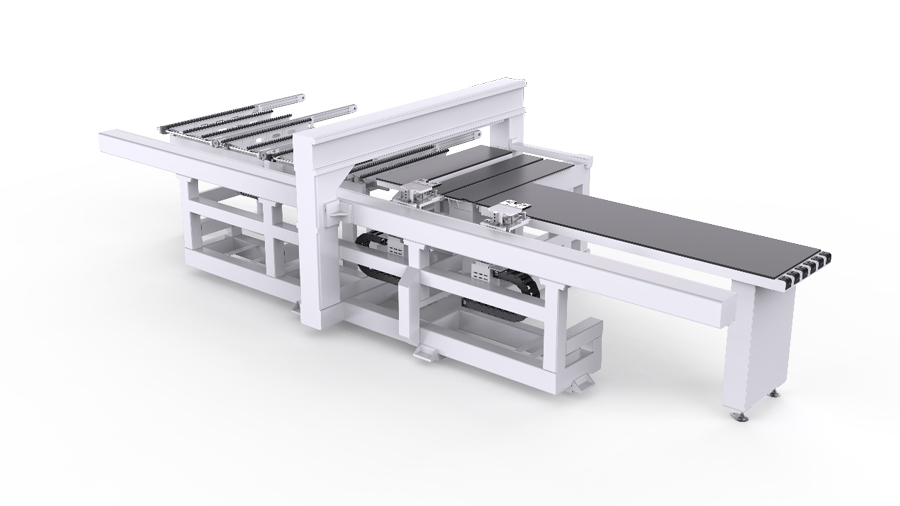
A wood CNC machine can help a furniture factory cut panels, drill hardware holes, route grooves, add labels, and process repeatable parts with less manual handling. But the right purchase is rarely decided by the lowest quote, the biggest spindle, or the longest feature list.
For cabinet, wardrobe, office furniture, and custom panel-furniture producers, the better question is: which process is currently slowing down production?
If panel cutting, nesting, labelling, and part identification are limiting output, a CNC nesting machine may be the best starting point. If the bottleneck is hinge holes, dowel holes, horizontal drilling, or repeated panel turning, a CNC 6-sided drilling machine may have greater value. If both stages are constrained, the factory may need a connected workflow rather than one larger standalone machine.
Quick Answer: Which Wood CNC Machine Is Best for a Furniture Factory?
For most panel-furniture factories, the best wood CNC machine depends on the next constraint in the production flow:
- Choose a CNC nesting machine when cutting, grooving, routing, drilling, labelling, and panel identification are the main challenges.
- Choose a CNC 6-sided drilling machine when hole processing, horizontal drilling, hinge drilling, or manual panel turning is slowing the line.
- Choose a connected nesting-and-drilling solution when both cutting and drilling stages create queues or when batch-one production requires reliable part tracking.
- Consider a complete automated cell only after checking material flow, downstream edge banding capacity, software integration, and operator requirements.
A machine should fit the factory's actual panels, order mix, shift pattern, software, and available floor space, not an idealized production plan.
Types of Wood CNC Machines Used in Furniture Manufacturing
3-Axis CNC Routers
A 3-axis CNC router moves the tool in X, Y, and Z directions. It is commonly used for flat sheet cutting, grooving, basic drilling, nesting, and 2D or 2.5D routing.
For furniture production, 3-axis routing is often suitable for cutting cabinet sides, shelves, backs, door blanks, worktops, and flat-pack components from MDF, plywood, particleboard, or similar panel materials.
It is a practical option when the factory mainly needs repeatable flat-panel processing. However, a standard router may not remove downstream drilling bottlenecks, especially when parts require many side holes, connector holes, hinge cups, or accurate six-sided processing.
4-Axis and Rotary CNC Machines
A 4-axis CNC machine adds rotary or multi-directional capability. It is more relevant when a factory produces curved furniture components, table legs, decorative columns, shaped solid-wood parts, or complex three-dimensional profiles.
This machine type can be valuable for solid wood furniture specialists, door producers, and factories with decorative machining requirements. It is usually less central for a panel-furniture plant whose main challenge is high-mix cabinet production.
Before investing in additional axes, confirm that curved or solid-wood components are a meaningful and recurring share of your orders. A more complex machine is not automatically a more productive one for flat-panel work.
CNC Nesting Machines
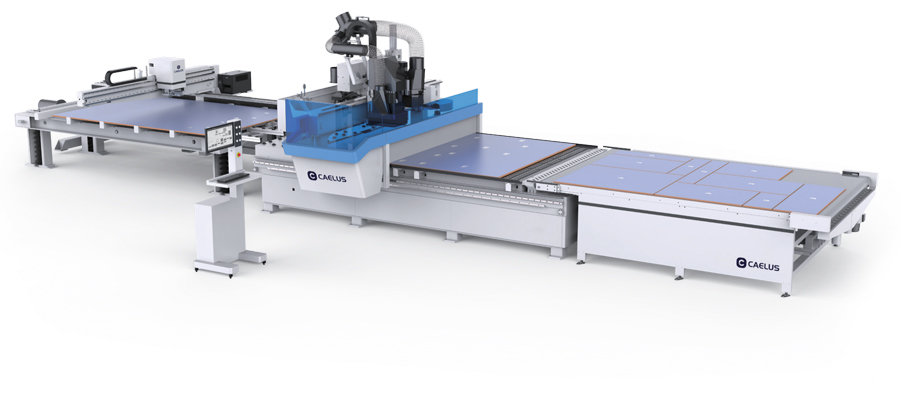
A CNC nesting machine is designed for efficient panel processing. It can combine nesting, cutting, routing, grooving, drilling, labelling, and outfeed in one workflow.
For custom cabinet and wardrobe manufacturers, nesting can reduce the number of manual steps between sheet loading and part sorting. The value is not only in cutting shapes from a panel. It is also in keeping each part connected to the correct order, machining program, and downstream process.
CAELUS CNC nesting solutions are built for panel-furniture workflows that include labelling, drilling, grooving, routing, cutting, and outfeed. The C3A model lists a 13.2 kW milling unit, a 16-position tool changer, six automatically controlled vacuum zones, and optional drilling capability with 12 vertical and 8 horizontal spindles plus a grooving saw.
For factories handling many cabinet orders with different dimensions, labels can be as important as cutting speed. A correctly identified panel can move to drilling, edge banding, sorting, and assembly with less dependence on manual recognition.
CNC 6-Sided Drilling Machines
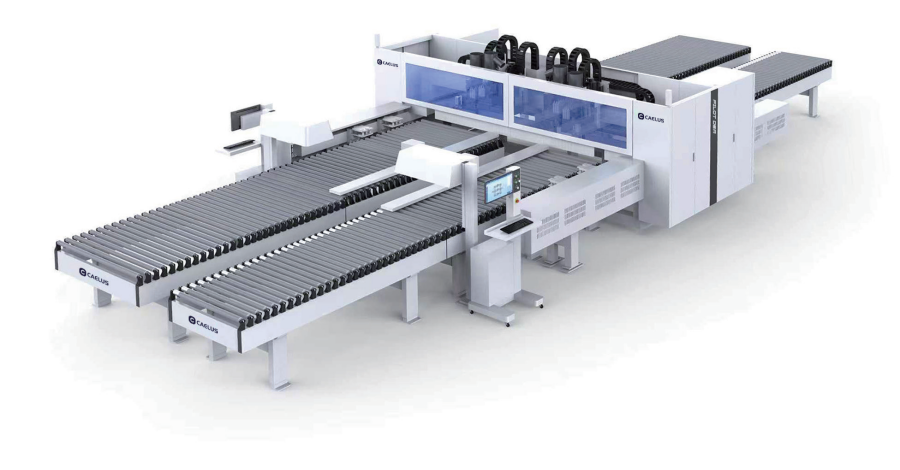
A CNC 6-sided drilling machine is built for precise panel hole processing. It can process top, bottom, and side faces without relying on repeated manual repositioning.
This capability is particularly useful for cabinet sides, shelves, doors, drawers, wardrobes, office furniture, and custom panel components with hinge holes, blind holes, through holes, connector holes, horizontal holes, grooves, or small milling requirements.
CAELUS offers several CNC 6-sided drilling machine options for different factory capacities:
The D5S CNC 6-Sided Drilling Center supports six-sided drilling, horizontal drilling, grooving, and milling. Its published drilling configuration includes two top drilling blocks with 26 vertical and 18 horizontal drilling positions, plus one bottom drilling block with nine vertical positions. It supports a maximum drill diameter of 35 mm and a maximum processing depth of 45 mm.
The D5A CNC Automated 6-Sided Drilling Center is designed for automated single-channel processing and lists two-plus-one drilling heads with 53 tools. It also supports barcode scanning and automatic handling of scan errors.
The D6A CNC Dual Channel 6-Sided Drilling Center is a dual-channel solution with six coordinated drilling heads for factories that need continuous, higher-volume panel processing.
CNC Nesting Machine vs. CNC 6-Sided Drilling Machine
| Decision Point | CNC Nesting Machine | CNC 6-Sided Drilling Machine |
|---|---|---|
| Main purpose | Cutting, nesting, routing, grooving, labelling | Hole processing, horizontal drilling, hinge and connector holes |
| Typical starting material | Full sheet panels | Cut and identified furniture parts |
| Main bottleneck solved | Panel cutting and part identification | Drilling queues and manual panel turning |
| Best suited for | Cabinets, wardrobes, custom panel furniture | Cabinets and furniture parts with frequent hole patterns |
| Important checks | Vacuum hold-down, tool changer, labels, software | Hole patterns, panel size range, loading method, software |
| Common next process | Drilling, edge banding, sorting | Edge banding, sorting, assembly |
A nesting machine cannot automatically replace a dedicated drilling center in every factory. Likewise, a drilling machine cannot solve sheet optimization, label accuracy, or cutting flow problems.
If your operators are spending too much time flipping panels to access different faces, evaluate six-sided drilling. If they are spending too much time identifying cut parts, changing tools, moving sheets, or preparing labels, evaluate nesting and labelling first.
Wood CNC Machine Price: What Should a Furniture Factory Budget?
A wood CNC machine price can range from approximately US$5,000 to US$150,000 or more, depending on machine size, structural design, spindle, drilling configuration, automation, software, installation scope, and service requirements. For planning purposes, furniture factories can use these broad budget tiers:
| Budget Tier | Typical Planning Range | Common Use |
|---|---|---|
| Entry-level | US$5,000–$15,000 | Small workshops, prototypes, basic panel processing |
| Mid-range | US$15,000–$40,000 | Growing furniture factories, stronger frames, ATC and production features |
| Industrial | US$40,000–$150,000+ | Larger factories, automation, drilling centers, loading/unloading and connected workflows |
The machine quote is only one part of the investment. A reliable budget should also include:
- Tooling, holders, and replacement cutters
- Vacuum pumps, dust extraction, and compressed air
- Electrical preparation and factory utilities
- Software, CAM, ERP, barcode, or labelling integration
- Freight, installation, commissioning, and training
- Planned maintenance, spare parts, and service support
- The cost of downtime during installation or changeover
Do not compare two quotations only by table size or spindle power. Two CNC machine for wood options with similar working areas can have very different costs because of frame rigidity, servo systems, tool changers, drilling units, vacuum systems, automation, controls, and support scope.
Key Specifications That Matter More Than Marketing Claims
Work Area and Panel Range
Check the panel sizes you process today, but also consider the products you expect to make in the next three to five years. A machine that is too small can create handling problems; a machine that is oversized can consume floor space and capital without solving the real bottleneck.
Spindle, Tool Changer, and Drilling Configuration
Ask how many tools are needed in a typical program, how often operators change them, and whether drilling, grooving, and routing must happen in the same cycle.
An automatic tool changer can be valuable when programs use multiple cutters. It may be less important when the process uses only a small, stable tool set.
Vacuum Hold-Down
Vacuum performance affects panel stability, cut quality, and operator confidence. It is especially important for small parts, thin panels, and nested layouts.
A useful supplier discussion should cover vacuum zones, pump type, workpiece size, material condition, and how the system handles small or irregular parts.
Software, Barcodes, and ERP Compatibility
In custom furniture production, information flow can be as important as mechanical capability.
Ask whether the equipment can receive reliable production data from your current software. Verify how labels are created, scanned, and linked to machining programs. If an operator must manually match every part to every program, the factory may simply move its bottleneck from cutting to data handling.
Dust Collection and Safety
Dust collection should be included in equipment planning from the beginning. Wood dust is associated with respiratory and other health hazards, and source-level local exhaust ventilation is a primary control method.
For U.S. factories, OSHA identifies wood dust exposure limits of 15 mg/m³ for total dust and 5 mg/m³ for the respirable fraction as an 8-hour time-weighted average. Local requirements vary by market, so confirm applicable regulations with qualified local safety professionals. Machine guarding, emergency controls, maintenance access, electrical protection, and operator training should be considered before installation—not after commissioning.
Furniture Factory Applications
A wood CNC machine can support different applications across a furniture plant:
- Cabinets and wardrobes: nested panels, shelf holes, hinge holes, grooves, and connector drilling.
- Kitchen and bathroom furniture: repeatable box parts, door components, cut-outs, and hardware positions.
- Office and retail furniture: modular panels, workstation components, display units, and repeated fittings.
- Custom furniture: batch-one labelling, flexible machining, and reliable part identification.
- Solid wood components: shaped rails, decorative panels, curved parts, and selected 4-axis applications.
The best application is not the most visually impressive one. It is the process where repeatability, part tracking, accuracy, or labor flow is currently affecting delivery time and quality.
A Practical Eight-Step Buying Process
- List your main products, panel materials, thicknesses, and hole patterns.
- Measure the actual bottleneck for at least five production days.
- Record cutting time, drilling time, waiting time, manual handling, and rework.
- Decide whether cutting, drilling, labelling, or material flow is the priority.
- Create a total-cost budget, not only a machine-price budget.
- Check software, labels, ERP, edge banding, and downstream compatibility.
- Run representative sample panels using real drawings and real hardware requirements.
- Confirm installation, training, acceptance testing, maintenance, and spare-parts terms in writing.
FAQ
Q1. What is the best wood CNC machine for cabinet production?
A: For cabinet factories, a CNC nesting machine is often the best choice when sheet cutting, grooving, drilling, labelling, and part flow are the main issues. A CNC 6-sided drilling machine becomes more valuable when hole processing and panel turning are slowing production.
Q2. Can a CNC nesting machine replace a CNC 6-sided drilling machine?
A: Not always. A nesting machine can perform certain drilling tasks, but a dedicated CNC 6-sided drilling machine is designed for efficient multi-face and horizontal-hole processing. The right choice depends on hole complexity, order volume, and production flow.
Q3. How much does a wood CNC machine cost?
A: A wood CNC machine price commonly ranges from about US$5,000 to US$150,000 or more. Final cost depends on configuration, automation level, auxiliary equipment, installation, software, and service scope.
Q4. What should I send before requesting a CNC machine quote?
A: Send panel drawings, material and thickness ranges, typical daily output, hole patterns, factory layout, existing machines, software information, and your target installation date.
Choose the Next Step That Removes Your Real Bottleneck
The right wood CNC machine is not necessarily the biggest or most automated option. It is the solution that fits your furniture products, production data, operator workflow, and future expansion plan.
For a factory-specific recommendation, share your panel drawings, order structure, current workflow, and production target with CAELUS.