

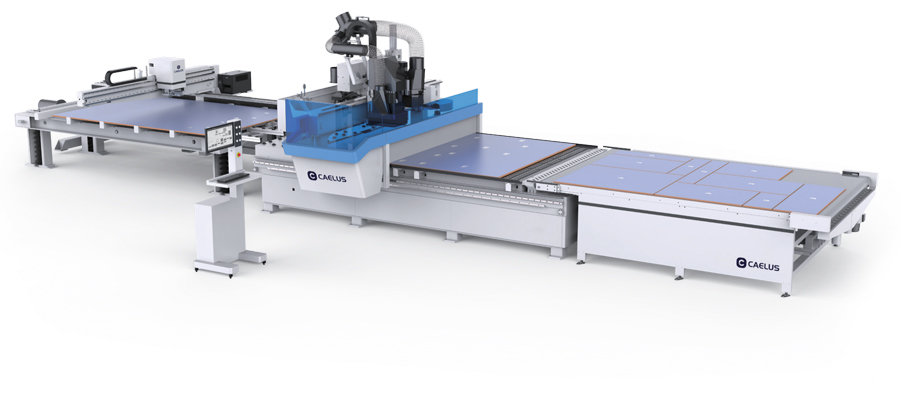
A wood CNC machine turns digital production data into controlled cutting, drilling and routing movements. The design defines the part, manufacturing software plans the toolpath, and the CNC controller coordinates motors, tools and workholding systems. In a furniture factory, that process may include nesting a full sheet, printing labels, cutting panels, machining grooves and drilling connection holes on several faces.
Wood CNC Machine Is a Category, Not One Machine
The term wood CNC machine covers several systems. A general CNC router cuts profiles, pockets and engravings. A CNC nesting machine arranges many cabinet parts on MDF, plywood or particleboard, then cuts and labels them. A CNC six sided drilling machine handles individual panels and machines the two broad faces and four edges without manual flipping.
They solve different problems. A sign shop may need a versatile router. A custom cabinet factory may gain more from nesting and labelling. A plant losing time to manual panel turning may need a six sided drilling center.
How the Digital File Becomes a Finished Part
1. Design and production data are prepared
The process starts with a drawing, cabinet design or order file. CAD software defines dimensions, profiles, holes and grooves. In panel furniture production, the data may also include material, thickness, grain direction, edge banding instructions, hardware positions, part ID and order number.
A CNC machine also repeats data mistakes. Incorrect thickness, edge allowance or hole references can produce an unusable batch.
2. CAM software creates the machining strategy
CAM software converts the design into toolpaths. The operator or programmer selects the tool, spindle speed, feed rate, cutting depth and order of operations. Nesting software adds another task by arranging multiple parts on a full sheet while considering tool diameter, part spacing, grain direction and workholding.
The layout must balance material yield with grain direction, small part stability and downstream sorting.
3. The controller receives machine readable instructions
After toolpaths are checked, a post processor converts them into a format the machine controller can use. General routers often use G-code. Furniture production systems may also exchange DXF, MPR, XML or manufacturer specific data.
The controller interprets the program and tells the drives and motors where to move. The spindle supplies cutting power, while the motion system positions the tool or panel.
4. The material is identified and secured
A sheet on a nesting machine is usually held on a vacuum table. The spoilboard allows air to pass through and supports through cutting. Vacuum zoning helps concentrate holding force where it is needed. On a six sided drilling machine, servo controlled grippers position an individual panel while an air flotation table supports the surface.
Workholding affects accuracy and safety. Operators should check seals, spoilboard condition, panel flatness, clamp position and small part stability before running a new job.
5. Motors create coordinated movement
On a typical three axis router, X and Y position the cutting head across the work area, while Z controls height and cutting depth. Servo or stepper motors drive the axes. Axis orientation can vary, so operators should follow the machine coordinate display.
The spindle rotates the tool at the programmed speed. The machine can profile panels, drill holes, cut pockets or machine grooves. An automatic tool changer supports several operations in one program.
6. Parts are labelled, checked and sent downstream
Each part must reach edge banding, drilling, sorting and assembly with the correct identity. Labels can carry order, cabinet, part and edge information, plus the next machining program.
A fast router still leaves a factory waiting if labels are unclear, parts are mixed or drilling cannot keep up.
How CNC Nesting Works in Furniture Production
A CNC nesting machine starts with a full sheet and a component list. Software places parts, creates toolpaths and links each part to production data. The machine can then label, drill, groove, route, cut and discharge them.
The CAELUS C3A automated nesting and labelling line uses a 13.2 kW HSK F63 spindle, a 16 position tool changer and six controlled vacuum zones. Its published panel range is up to 3,100 by 2,100 mm and 10 to 40 mm thick. ERP integration allows order data to follow the panel.
The C3LA is designed for panels up to 4,200 by 2,100 mm and lists a 10 to 25 mm thickness range. Buyers should still test their normal sheets, difficult small parts and production files.
How CNC Six Sided Drilling Works
Six sided drilling begins after a panel is cut and identified. A scanner calls the program, grippers establish the reference, upper and lower units machine the broad faces, and horizontal tools reach the four edges. Optional tools can add grooves or connector features.
Six sided describes the surfaces reached, not a six axis machining center. The operator normally does not need to flip and reference the panel between face and edge operations.
The CAELUS D5A uses 2 plus 1 drilling heads with 53 tools and supports a maximum drill diameter of 35 mm. Its double gripper is listed up to 140 m per minute, with a published positioning tolerance no more than 0.3 mm. It accepts DXF, MPR and XML data. For higher parallel capacity, the D6A uses dual channels and six coordinated drilling heads.
These are machine specifications, not guaranteed factory output. Real cycle time depends on panel dimensions, hole count, grooves, tool changes, program optimization, loading and downstream capacity.
CNC Router, Nesting Machine or Six Sided Drill?
| Production need | Suitable direction | Main consideration |
|---|---|---|
| Decorative panels, signs and varied profiles | General CNC router | Flexibility and suitable tooling |
| Full sheet cabinet parts and mixed orders | CNC nesting machine | Material flow, labels, vacuum and software |
| Face and edge holes in finished panels | CNC six sided drilling | Part range, drill configuration and clamping |
| Connected custom furniture production | Nesting plus edge banding and six sided drilling | Data continuity and balanced capacity |
Nesting and six sided drilling are often complementary. Nesting prepares and labels parts, edge banding finishes the edges, and six sided drilling produces assembly holes. Spindle power or travel speed alone does not reveal the production bottleneck.
What Should You Verify Before Buying?
Start with your own production data rather than a demonstration part. Prepare the smallest, largest and most common panels, along with several real order files. Confirm material type, thickness, hole patterns, grooves, connectors and edge requirements.
During a sample test, time the complete cycle from file or barcode loading to outfeed. Measure hole position, diameter and depth. Inspect surfaces and test unreadable labels, incorrect panel sizes and missing programs.
Check footprint, maintenance access, power, compressed air, extraction, software, training and spare parts. Maximum speed is only one part of usable capacity.
FAQ
Q1. Does every wood CNC machine use G-code?
A: Many CNC routers use G-code, but furniture production equipment may also use DXF, MPR, XML or software specific formats. File compatibility should be tested with real production data and the correct post processor.
Q2. Can a nesting CNC machine drill all six sides?
A: Usually not. A nesting machine is optimized for full sheet cutting and face machining. A six sided drilling center is designed to reach the two broad faces and four edges of individual panels. Many furniture factories use both processes.
Q3. How many operators does a wood CNC machine require?
A: The answer depends on loading, labelling, outfeed, maintenance and the surrounding line. Automation can reduce repeated handling, but operators are still needed for production data, tooling, quality checks and exception management.
Q4. How can a factory estimate real output?
A: Use representative orders and measure the full cycle, including scanning, loading, machining, tool changes and outfeed. Apply a realistic uptime factor and confirm that downstream edge banding, drilling or assembly can accept the output.
Conclusion
A wood CNC machine works by turning digital design and production data into coordinated cutting, drilling and routing movements. CAD defines the part, CAM plans the toolpaths and the controller guides the motors, spindle and workholding system. For furniture makers, the right choice depends on the workflow: a CNC router handles flexible machining, a nesting machine processes and labels sheet stock, and a six sided drilling center completes face and edge holes with less manual handling.